



Abraham Harold Maslow was an American psychologist who, in the mid twentieth century, developed a new way of thinking about what humans need to function well. This approach to psychological study, which had previously been focused on poor-functioning (when things go wrong), became known as Humanist Psychology. His famous conceptual contribution is his human motivation theory. He posed the questions: What makes us motivated as humans? What drives us in our actions to live, second-to-second, day-to-day, year-to-year in our lifetimes? His hierarchy of needs framework sets out the idea that we are motivated to satisfy different needs and, such needs sit within a loosely prioritized hierarchy. Self-actualization is his term for the highest-level need within the initial framing of the hierarchy. When the need for self-actualization is satisfied, as a human we have reached our full potential. In his words, to be self-actualized is to be all that one can be.
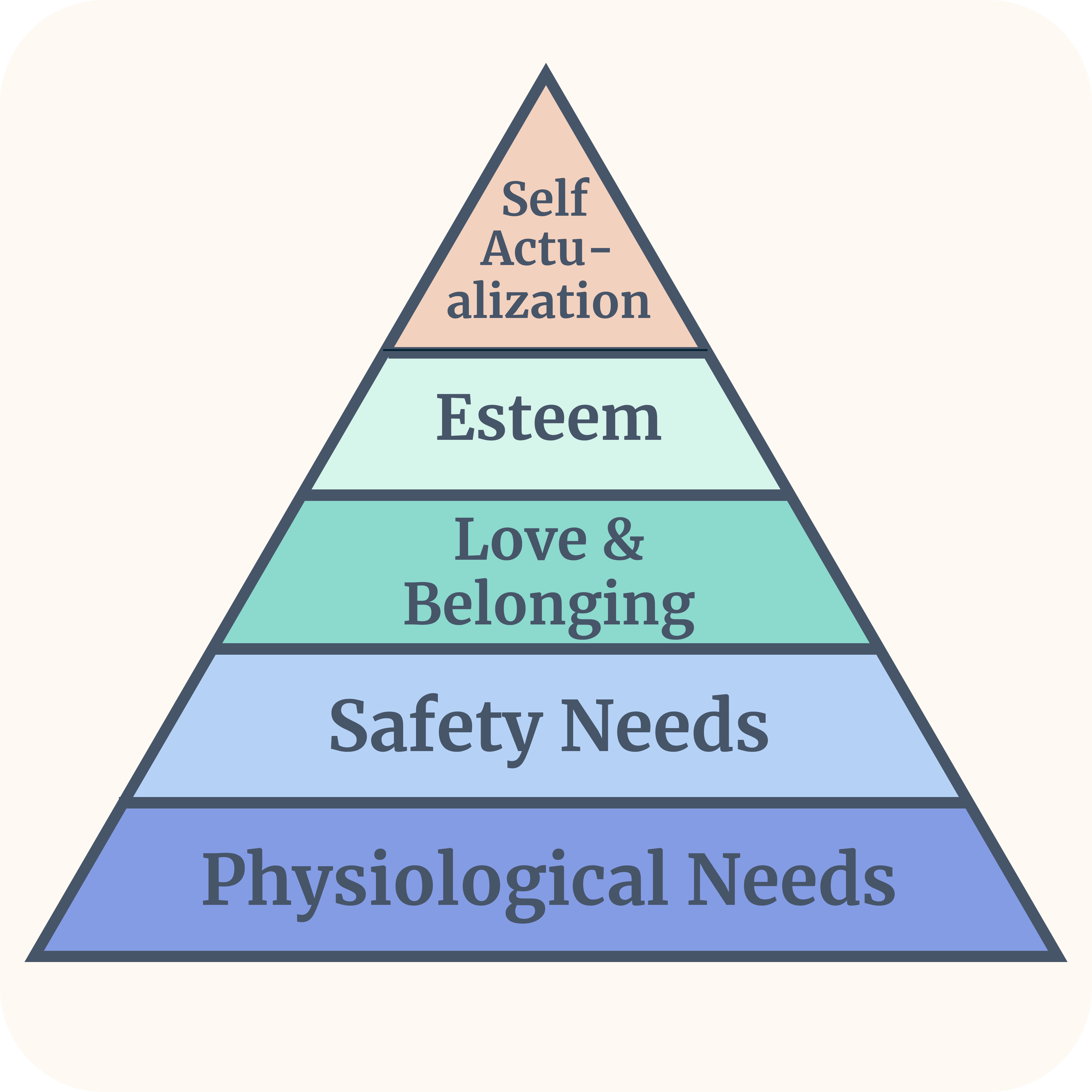
Say the words self-actualization to the average person on the street and a significant, non-zero, percentage of them will react. Something will trigger in the back of their mind about psychology, something about being perfect or ideal. I would expect that most of you who have actively clicked through to this post are already familiar with Maslow and his hierarchy of needs framework, your memory was more than just jogged by the accompanying pyramid diagram above that depicts the hierarchy. Psychologists, academically however, have moved on from Maslow. The modern study of wellbeing (often synonymous with happiness) has turned away from Maslow. The criticisms of Maslow’s ideas are primarily that self-actualization is not well defined or measurable, and empirically the priority of needs (the hierarchy) is not demonstrable. In this post, I would like to make the case for Maslow and his ideas, in the context of their importance in the current discourse of wellbeing and happiness.
Maslow’s work is foundational. He is seen as the father of humanist psychology and his work provides a link between philosophical discourse and modern psychology. Maslow appreciated (in discussion and interviews) that his framework and humanistic psychology was a work in progress and would need to be tested and developed by himself and others. He refined it over time and introduced additional levels beyond the original five, including cognitive needs, aesthetic needs and the need for self-transcendence. These additions broadened the scope of the hierarchy and made it more consistent with the full range of human motivation. They also bring Maslow closer to a much older tradition of thinking about human flourishing. The question of what it means to live well is not new. It has been central to philosophy for more than two thousand years, and in the Western tradition it is most closely associated with Aristotle. Maslow’s ideas offer a modern psychological vocabulary for the themes that Aristotle explored through ethics, virtue and the idea of eudaimonia.
Maslow’s framework is holistic. The reason why Maslow still matters is not only historical. The hierarchy is grounded on physiological needs, moves up through safety and psychological stability, top out in the higher needs associated with growth, meaning and purpose. Many modern wellbeing theories focus primarily on psychological factors. Maslow’s hierarchy spans the physical, psycho-physical, psychological, psycho-social and existential. It also feels intuitive. We recognize that basic needs must be met before higher aims can be pursued. We understand that growth requires stability, and that meaning becomes possible when life is not dominated by deprivation. The hierarchy mirrors the way people often describe their own lives.
Modern wellbeing research has moved in new directions. Frameworks such as Ryan and Deci’s Self Determination Theory and Ryff’s model of psychological wellbeing offer alternative ways of describing what humans need in order to function well. Positive psychology has introduced distinctions between hedonia and eudaimonia, between pleasure and purpose. Yet still, Maslow’s hierarchy remains relevant because it allows for integration of these themes into a single structure. It acknowledges that wellbeing involves both the reduction of deficiency and the pursuit of growth. It recognises that human motivation is layered, and that flourishing requires attention to the satisfaction of both basic conditions and higher aspirations.
Maslow’s framework is catchy. If you’ve learned about his hierarchy framework in a psych’ class in its pure format, or related subject study where the framework has been applied, then it tends to strike the imagination and is immediately memorable. A significant reason why the hierarchy is memorable is due to self-actualization. It has always been, and remains, somewhat of a mystical concept. What is self-actualization? How do you achieve it? Maslow was kind enough to generally describe it and to identify that Abraham Lincoln and Albert Eisnstein, among an exulted group, definitely had it. Put on pedestals as targets for personal growth, giving these two as self-actualized exemplars definitely added to the level of mysticism around self-actualization, but in a good way.
Maslow is the OG. Over the years his ideas have developed a cultural identity not least in part because of the way they were presented. ‘The pyramid’ was not Maslow’s invention. It was introduced in 1960 by Charles D McDermid in a business journal. The visual simplicity of the pyramid made the hierarchy easy to teach and easy to remember. It entered business schools, management training, marketing, education and healthcare. It became part of the vocabulary of leadership, motivation and personal development. Even today, the hierarchy appears in discussions of workplace culture, coaching, sports science and wellbeing. It has become a cultural reference point that extends far beyond academic psychology.
Maslow’s secret advantage is that his framework resonates with our lived experience. It feels right. It makes sense. It tells us that some needs are essential and urgent, while others might be aspirational and developmental. It acknowledges that the highest forms of human fulfilment are not easy to define or achieve, and not always possible to sustain. It reflects the reality that life involves different priorities and needs are not always met within the hierarchy. It also preserves a sense of mystery. Self-actualization is not prescriptive and invites personal interpretation. It encourages people to consider what it means to be fully themselves. That openness is part of its appeal.
The details of the hierarchy can be debated, and psychologists rightly point out its limitations. But the framework has remained relevant for more than seventy years because it captures something important about human life. It reads like a guide rather than a rule book. It helps us think about what we need in order to be well functioning, fulfilled and happy. It reminds us that flourishing is not only about feeling good but about living well. It is this combination of intuition, breadth and aspiration that explains why Maslow still matters, and why his ideas continue to shape the conversation about wellbeing today.
Maslow is still everywhere. I freely admit that my attention is heightened to any references that I might encounter, but I leave you with two examples of my recent experience.
1) In my social media feed, a GQ article popped up entitled “The best T-Shirts for men, Period” dated August 25, 2026. The tag line which was printed at the top of the post was “In menswear’s hierarchy of needs, the T-Shirt lies at the base of the pyramid.” The article, which I did not click through to, appeared to be a generic article about T-Shirts. Unsurprisingly, my immediate reaction was a double take. Was this an example of Meta stalking me with targeted posts? Then I wondered whether I was being AI spearfished. Could the tag line have been automatically generated by AI (monitoring my internet traffic) with the intention of catching my attention? But no, clicking through to the GQ post on its own profile page, I confirm the same tag line to be attached to the post for all readers, not just for me.
2) I am a fan of the HBO-BBC show, Industry, a financial thriller drama. It is an often decadent, sometimes debaucherous, exploration of the exploits of a pair of young fresh college graduates who we first see joining the London branch of a bulge bracket Wall Street bank. Now in its fourth season, we have followed the two heroines through countless trials and tribulations. They have been on journeys of discovery to find their fortunes and their place in a cutthroat world of financial markets, politics and corporate finance. Their paths have been on continuously intertwined, despite taking completely different directions after leaving their first banking jobs. Over time, they have been passionate friends and fierce adversaries in equal measure.
Aside from the compelling storylines, the show is a great watch for those who want to see a sensationalized and exaggerated view of the corporate finance industry. That said, at the end of the penultimate episode of this latest season our two heroines, Harper and Yasmin, meet after both narrowly avoiding personal and professional disaster by joining forces. They are sat in a quiet bar, ruminating on the ups and downs they have experienced in their lives and how well they have been able live up to life’s expectations.
Yasmin: I mean seriously, how the Fuck did we get here?
Harper: Fucked if I know.
Harper: What drives anyone anywhere?
Harper: Lack, and need…?
This extract of dialogue exchanged between the two characters doesn’t do the dramatization of the production any justice, and likely washed over most viewers, but to me they demonstrate that Maslow is not passe. He is very much of the present, front of mind of the young professionals sitting at that bar (and the young writers sitting behind them). Maslow matters.