


FINANCE & SOCIETY
Who Will Buy America’s Growing Debt?
Finding willing buyers may become the defining financial challenge of the decade.

The Price of Borrowing
If you live in the US or follow financial markets, you will probably be familiar with three related market concerns:
1) The US government runs a budget deficit. So far in 2026, it has spent $2 trillion more than it has collected in tax revenue.
2) The US government borrows by issuing Treasury securities. When it runs a deficit, it must issue additional debt; total federal debt has recently reached $40 trillion.
3) US Treasury yields—the returns investors demand on government debt—have risen to levels not seen for many years. Despite the Treasury’s efforts to manage its borrowing, yields remain under upward pressure.
Rising Treasury yields an immediate concern as they affect far more than financial markets. They ultimately influence mortgage rates, business investment, government finances and the cost of borrowing throughout the economy
Much of the commentary about high government borrowing costs—which also influence borrowing costs for companies and individuals—focuses on how the Federal Reserve will set the federal funds rate. If the Fed keeps that rate high, or raises it because inflation remains persistent, markets may expect further upward pressure on Treasury yields. Existing bond yields rise when their market prices fall, while newly issued bonds must offer higher coupon rates when investor demand is weak.
Commentators also point to the rapidly rising federal debt, now around $40 trillion, and to continuing budget deficits that add to the borrowing requirement. The government must issue bonds both to refinance maturing debt and to fund new deficits. It therefore needs existing lenders to reinvest while also attracting additional capital.
Everything about this sounds bad, and I was curious to find out how bad it really is.
Of these two issues, the Federal Reserve’s policy rate is set primarily to control inflation. Because this is part of its normal mandate across the economic cycle, monetary policy alone should not create an extraordinary long-term effect on Treasury yields.
But the government debt? That’s more interesting and potentially presents a systemic shift.
For much of the past quarter-century—the period covered by my professional memory—US debt has been rising. During that time, the possibility of a US default has often been debated and, rightly, dismissed. Even with debt near $40 trillion and a debt-to-GDP ratio of 125%, I see little immediate risk that the government will fail to meet its obligations. The more plausible problem is one of price: the government may find too few investors willing to buy the volume of bonds it needs to issue, forcing it to offer higher coupons.
The real question: Who will keep buying?
So who owns the roughly $40 trillion of outstanding Treasury debt today? Are these investors likely to maintain their holdings? More importantly, will they increase them in line with further government borrowing?
Of the roughly $40 trillion in federal debt, the Peter G. Peterson Foundation estimates that about 80% ($32 trillion) is held by the public, while about 20% ($8 trillion) consists of intragovernmental holdings.
Intra-government bodies include the Social Security Old-Age and Survivors Insurance Trust Fund and the Federal Employees Retirement Fund and are effectively an internal IOU within the government.
A breakdown of the $32 trillion of external debt is shown below:
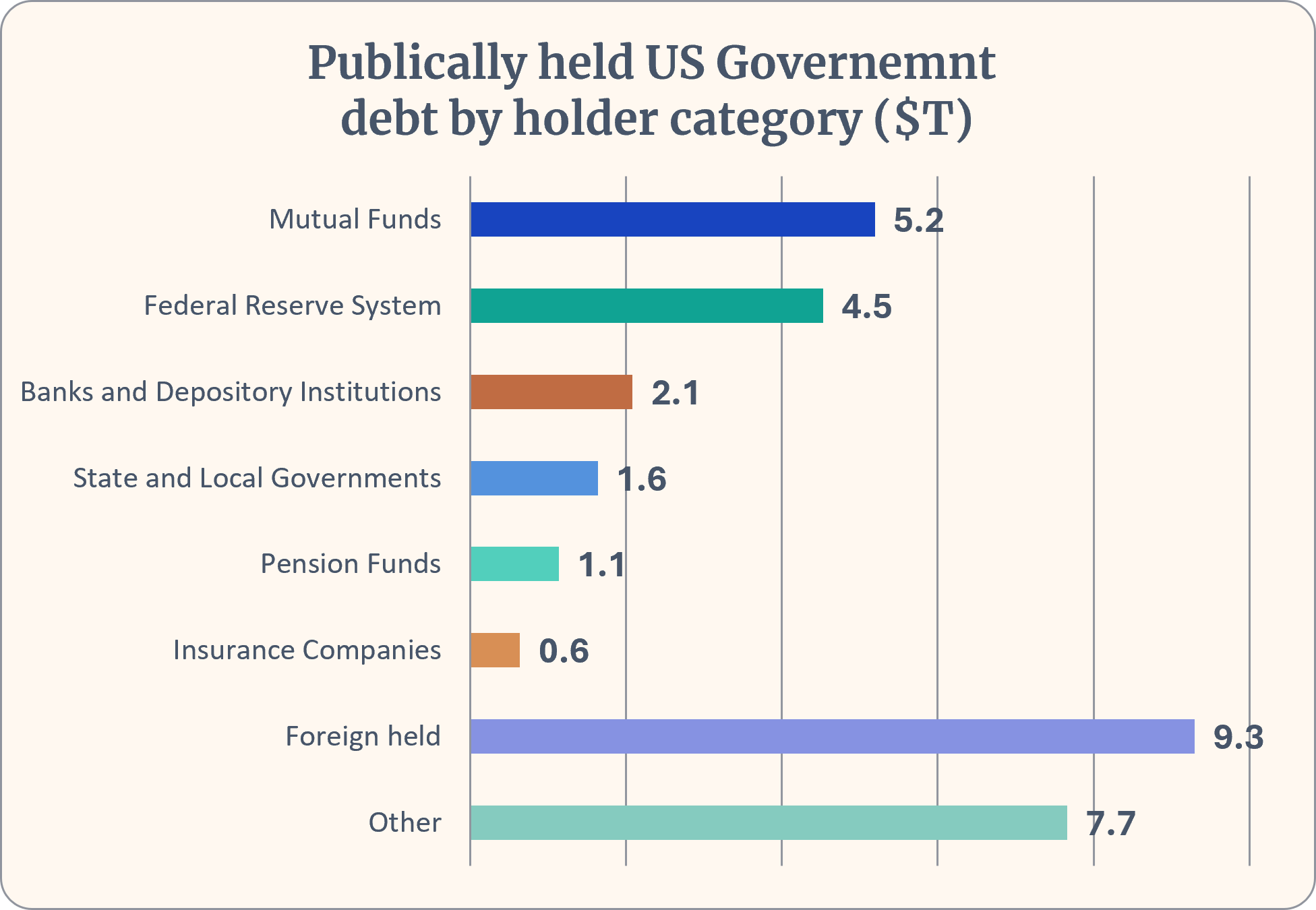
The key issue in this breakdown is not simply the size of each category, but whether its holdings are likely to grow fast enough to absorb future Treasury issuance.
Can domestic investors absorb more debt?
Among the smaller categories—insurance companies, pension funds, banks and other depository institutions—I would not expect holdings to fall sharply, but neither would I expect them to grow much faster than the economy. On that assumption, these groups would provide limited support for debt increasing at roughly $3 trillion a year. State and local governments are also likely to hold federal debt partly against their own pension liabilities, which generally change more slowly.
The Federal Reserve System holding of $4.5 trillion is comprised primarily of the government’s quantitative easing efforts from the pandemic and the global financial crisis. It’s securities portfolio peaked at around $9 trillion in 2022. As these were extraordinary measures, I would expect holdings to fall, rather than rise over time.
Mutual funds holdings of $5.2 trillion, much of it as long-term investments in pension portfolios. Here, we might see two effects. Firstly, an increase in bond mutual fund holdings as baby boomers and Generation X move towards and reach retirement, and shift the amount of their pension assets into fixed income assets. Second, a continued trend of reduction in bond mutual fund holdings as the traditional 60:40 equity-bond portfolio is losing favour among younger investors.
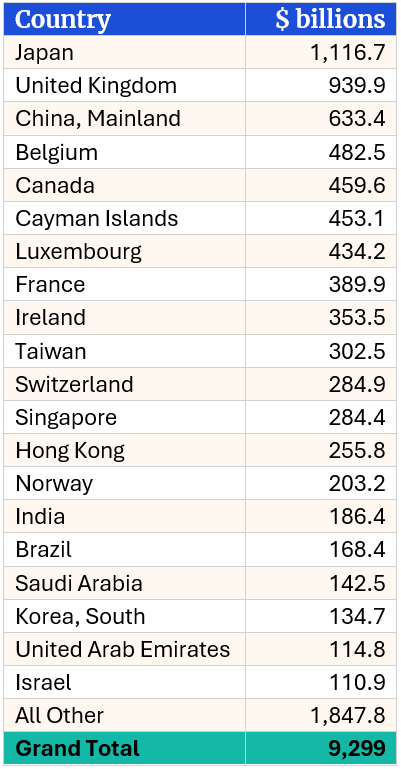
The largest category of holders is foreign investors, including foreign official institutions. As of June 2026, the US Treasury Department reported the following foreign holdings of Treasury securities.
Why foreign demand depends on trade
These holdings partly reflect dollar reserves accumulated through international trade and capital flows. When a US company buys goods or services from a foreign company, payment may be made in dollars or in the seller’s local currency. If the exporter receives dollars, it may exchange them through its commercial bank; if the US importer buys foreign currency, a bank stands on the other side of that transaction. Depending on the country’s exchange-rate arrangements and financial flows, some of those dollars may ultimately be acquired by its central bank and added to foreign-exchange reserves.
If trade and financial flows between two countries broadly offset each other, neither central bank necessarily accumulates large balances of the other’s currency. When the US runs a trade deficit, however, dollars accumulate abroad. Foreign private holders or central banks may keep those dollars, exchange them for other currencies, or invest them in dollar-denominated assets such as US Treasury securities.
World Population Review lists the following countries as those with which the US recorded its largest trade deficits in 2025.
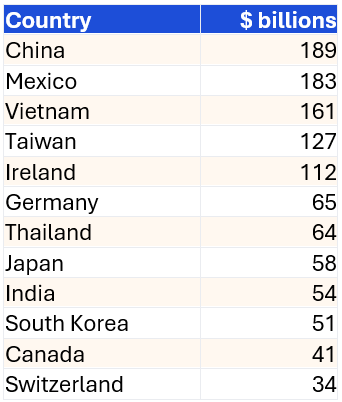
The total US trade deficit in 2025 was $902 billion, fractionally below the $904 billion recorded in 2024. This was despite tariffs introduced in April 2025 as part of the government’s effort to reduce the deficit.
The US trade deficit means that roughly $1 trillion continues to flow abroad each year, creating a pool of dollars that could be invested in Treasury securities. Yet some large holders are diversifying their reserves. China, for example, held around $1 trillion in US government debt in 2021 but has since reduced that figure to about $0.6 trillion.
The explanation took longer than I expected, but it leads to a simple conclusion: the US government’s challenge is not merely issuing an ever-growing volume of bonds, but finding investors willing to absorb them at acceptable yields.
Among the investor groups considered here, mutual funds could provide some of the demand needed to absorb additional supply. For that to happen, bonds must again offer a compelling combination of yield and diversification within portfolios such as the traditional 60:40 equity-bond mix. Foreign demand presents a different problem: reducing trade deficits and pursuing trade conflicts may leave foreign economies with fewer dollars to recycle into US assets, even as the still-large global trade deficit continues to place substantial dollar balances in overseas hands.
The demand question therefore has two parts: whether investors will absorb the additional supply and what yield they will require to do so. The first appears manageable for now, but the second may keep borrowing costs elevated.
A return to normal yields?
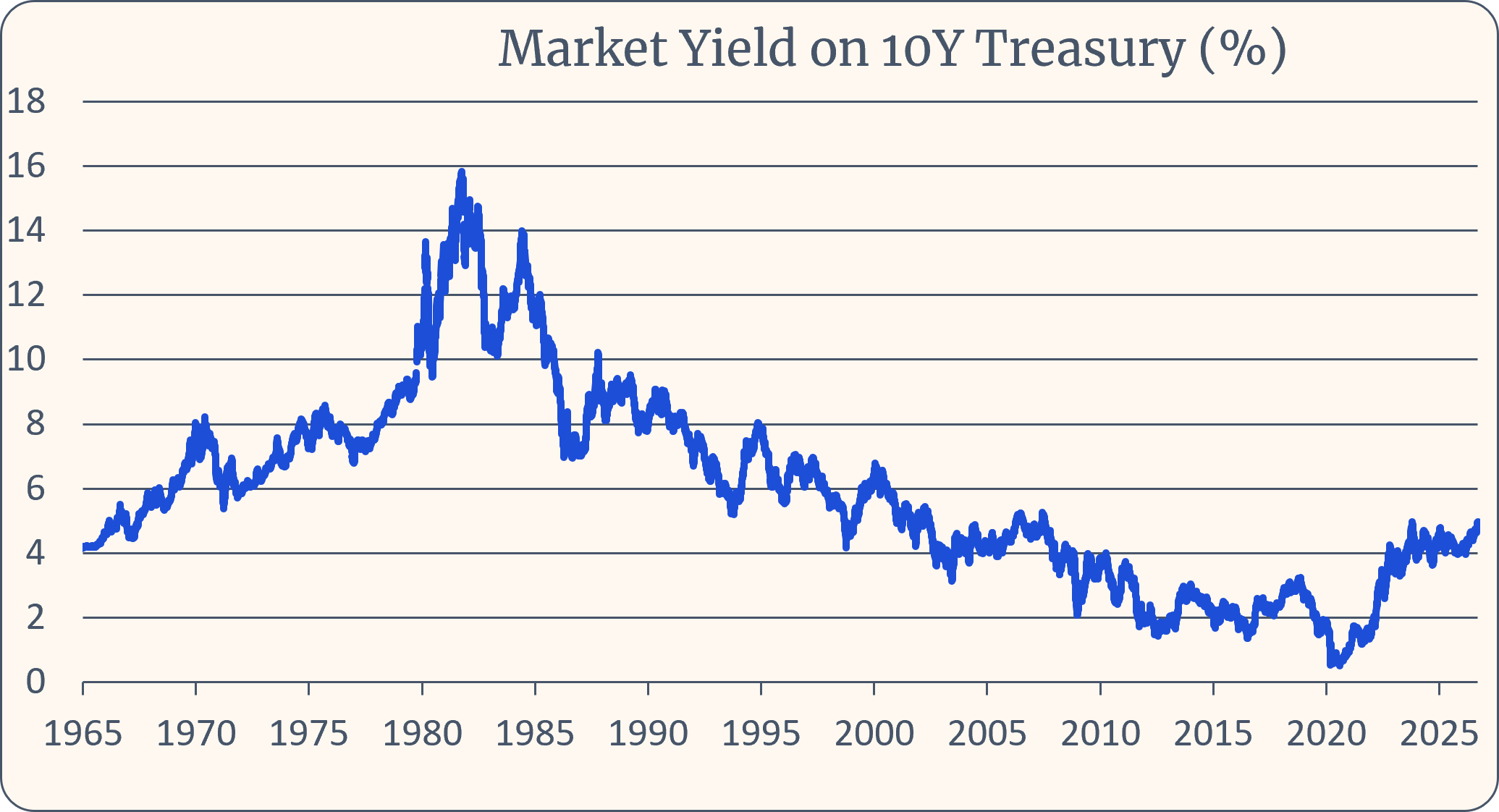
My final question is whether, assuming the government can continue to find buyers for its bonds, coupons and yields must keep rising to attract them—or whether today’s market simply marks a return to historically normal yields rather than the beginning of an extreme-rate era.
A 10-year Treasury yield above 5% looks unusual by the standards of the past 15 years. Yet that period—remarkably long though it was—was itself exceptional, shaped by unusually low policy rates and large-scale central-bank asset purchases.
About Finance & Society
Finance and Society is where I explore the economic, financial and demographic forces shaping our world, a subject that has been both my profession and my passion for decades.
If you’re interested in a different perspective on money, you may also enjoy my Actualize This series, which explores the relationship between money, wellbeing and human flourishing. Those articles focus less on markets and economics, and more on how money influences the lives we want to build.