



Finding a puzzle piece. Looking for a fit.
A few weeks ago, I came across a wealth pyramid on social media.
It was a diagram that defines different levels of wealth and comments on the typical financial perspective households sitting on each level faces. At the bottom sits the homeless and extremely poor. Above them are the those surviving on government assistance. Next come the middle class burdened by debt, followed by the upper middle class, with millionaires sitting at the top.
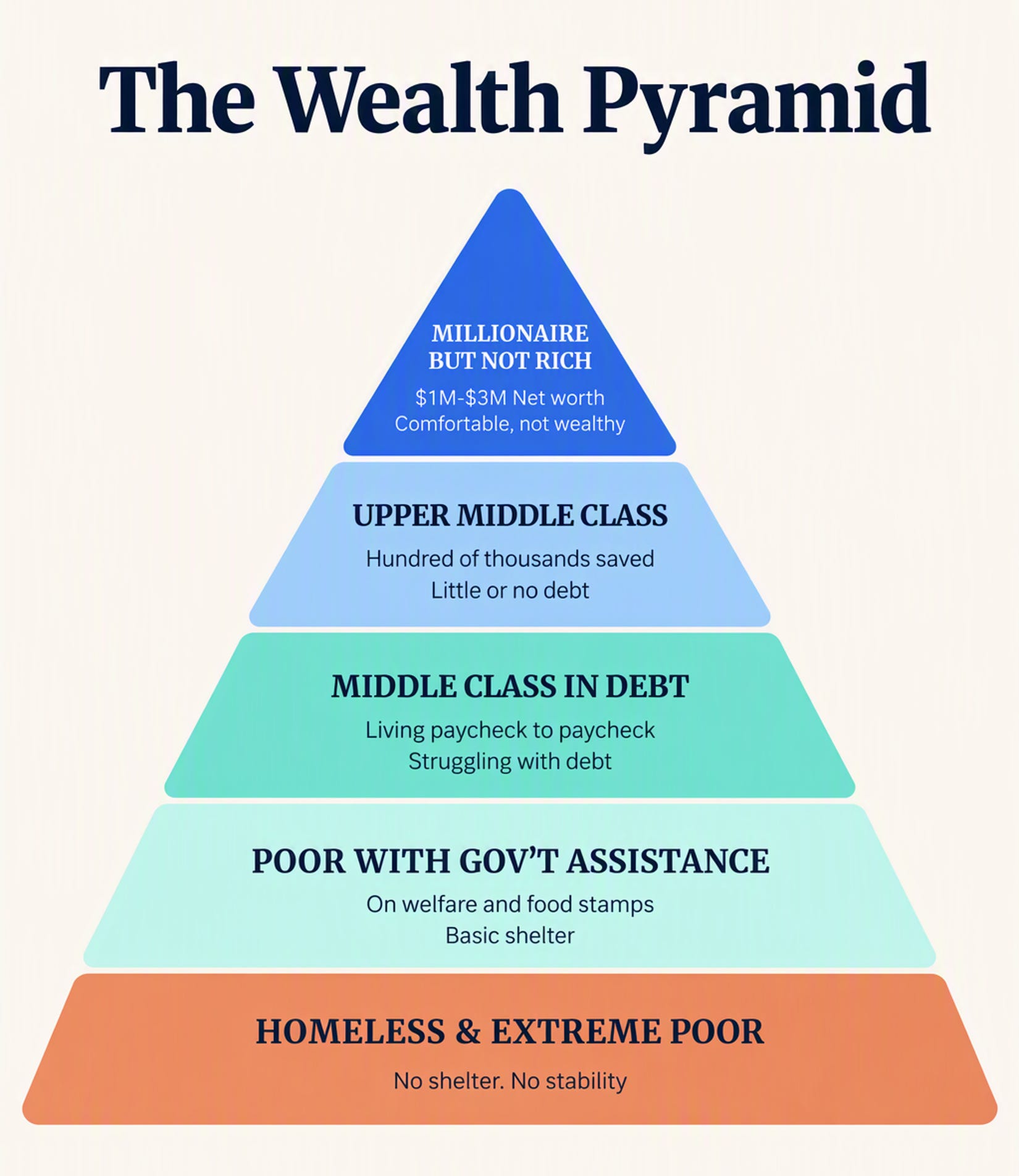
There was nothing particularly remarkable about the diagram itself. In fact, if you spend any time on social media, you might have seen similar graphics, used to make some point about inequality, class, privilege or success.
Yet, when I saw this diagram, I immediately felt challenged by it. I just couldn’t immediately explain why.
After spending the last few years thinking about money through the lens of Maslow’s hierarchy of needs and developing the Hierarchy of Money framework, I have developed something of a weakness for pyramids. Whenever I see one, my brain immediately starts looking for patterns and relationships. I guess the influence of Abraham Maslow’s hierarchy on my thinking is hardly a secret at this point.
My immediate reaction was not to decide whether the diagram was right or wrong.
Rather, I found myself asking a different question.
Does this relate to the Hierarchy of Money? And if so, how?
At first glance, it felt like it should. Or rather, I felt that this is the type of information which people are interested in, so I should try and make the connection.
Both frameworks are attempting to tell us something about the relationship between money and the human experience.
The challenge was figuring out exactly what that relationship might be.
The Pieces Didn’t Match.
My first instinct was to look for a direct mapping between the different wealth levels and Maslow’s hierarchy of needs.
After all, both frameworks are structured as hierarchies.
At the bottom of the wealth pyramid sits homelessness and extreme poverty. That certainly feels consistent with someone struggling to satisfy physiological needs and safety needs.
Food.
Shelter.
Security.
That part appears straightforward enough.
From there, it is tempting to continue the exercise.
Perhaps the poor focus primarily on safety needs.
Perhaps the middle class focus on belonging and esteem.
Perhaps the wealthy have largely solved these concerns and can focus on self-actualization.
Perhaps the pyramid can show us a progression up through Maslow’s hierarchy, with wealth acting as the mechanism that enables movement from one level to the next.
Two pyramids.
Five layers.
Everything apparently lining up perfectly. Could it be that simple? Perhaps the wealth strata in the pyramid that I saw would not line up, but by adjusting the wealth levels, could we make a match?
The problem however was, the more I thought about it, the less convincing it became.
A millionaire may still struggle with meaning and purpose.
A schoolteacher on an ordinary income may enjoy deep relationships, a strong sense of community and meaningful work.
A retiree of modest means may feel fulfilled and content.
Conversely, somebody with substantial wealth may still be searching for identity, belonging or direction.
The wealth levels don’t matter really, no matter how hard you try shifting them around.
This was hardly a revelation.
It was one of the central conclusions of the Hierarchy of Money.
Money matters enormously, particularly when it comes to satisfying lower-level needs. However, its influence becomes progressively weaker as we move towards growth needs and flourishing.
The problem was not that money doesn’t matter.
The problem was that wealth and need satisfaction are not the same thing.
At that point the neat mapping began to unravel.
So, if the wealth pyramid was not describing progress through Maslow’s hierarchy, then what exactly was it describing?
Finding a Common Edge.
For a while, I found myself stuck.
The original theory clearly wasn’t working, but I still couldn’t shake the feeling that the pyramid was connected to the Hierarchy of Money in some way.
The breakthrough came when I stopped looking at what separated the different layers and started looking at what they had in common.
Up until this point I had been asking a very Maslow-shaped question:
Which need does each wealth group correspond to?
It turned out that this was probably the wrong question.
A better question was:
What problem is each wealth group trying to solve?
The answer became clearer once I ignored the extremes and focused on the large middle section of the pyramid.
The poor receiving government assistance.
The indebted middle class.
The upper middle class.
The millionaire.
At first glance these groups appear to have very little in common.
Their incomes are different.
Their lifestyles are different.
Their opportunities are different.
Their concerns appear different.
Yet when viewed through the lens of finance, they are all attempting to achieve a version of the same thing.
Financial security.
Or perhaps more precisely:
Financial safety.
The poor individual is trying to make it safely through the coming weeks.
The indebted household is trying to make it safely through the coming months.
The upper-middle-class family is trying to make it safely through retirement.
The millionaire may be trying to ensure that wealth survives a comfortable retirement and supports the next generation as well.
The circumstances are different.
The numbers are different.
But the underlying objective is surprisingly similar.
The more I thought about it, the less the diagram looked like a hierarchy of wealth.
Instead, it started looking like a hierarchy of financial safety concerns.
Rotating the Puzzle Piece.
This was the point where everything finally started to make sense.
What if the different levels in the pyramid were not describing different needs at all?
What if they were describing different time horizons over which the same need was being managed?
For somebody experiencing homelessness or extreme poverty, safety may be measured in days.
Sometimes hours.
For somebody living on government assistance, safety may be measured in weeks.
For somebody living pay cheque to pay cheque, perhaps months.
For somebody building retirement savings, decades.
For somebody thinking about inheritance, estate planning and future generations, perhaps longer still.
The further we move up the pyramid, the further into the future people are attempting to create security and certainty.
The horizon expands.
Importantly, this does not necessarily mean that people higher up the pyramid have moved beyond safety concerns.
In many cases they are still focused on safety.
The difference is that the risks they are trying to manage exist much further into the future.
Suddenly the diagram looked very different.
It was no longer a hierarchy of needs.
It was not even primarily a hierarchy of wealth.
It was a hierarchy of safety horizons.
The need remains broadly the same.
What changes is the time horizon.
Seeing the Bigger Picture.
Up until this point, I had identified what appeared to be a useful pattern.
Different wealth levels seemed associated with different financial safety horizons.
The question was whether that observation had any use.
Why should the length of somebody’s financial safety horizon matter?
Crucially, what does it have to do with the Hierarchy of Money?
To answer that question, we need to revisit the original framework.
The central argument of the Hierarchy of Money was that money matters enormously at the bottom of Maslow’s hierarchy but progressively less as we move upwards through the growth needs associated with flourishing.
Money buys food.
Money buys shelter.
Money helps to buy security.
Money can help facilitate relationships, learning and self-development.
But it becomes increasingly difficult to purchase meaning, purpose, wisdom, creativity and self-actualization directly.
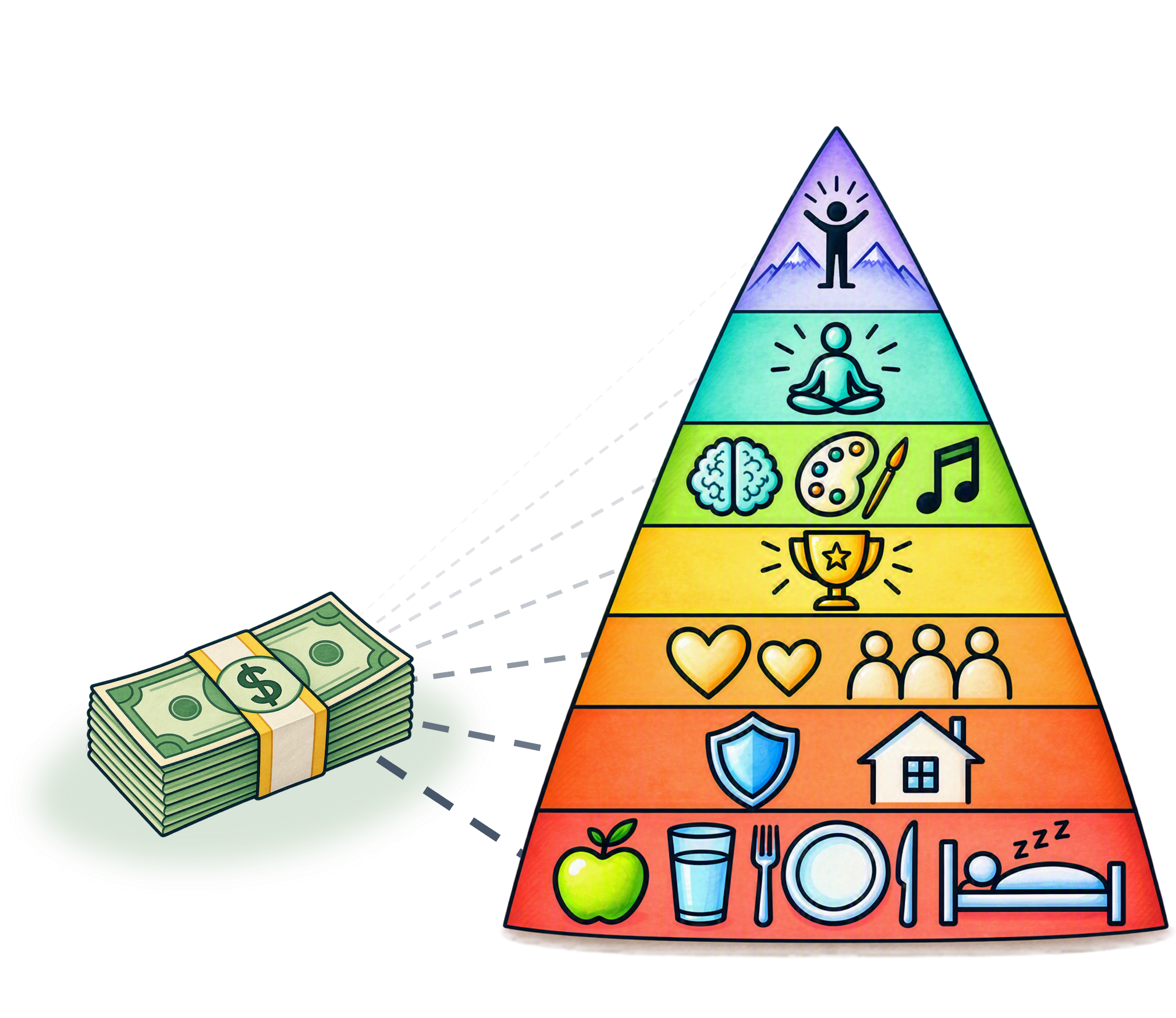
What the original framework did not fully explain is why people often appear focused on very different parts of the hierarchy despite living in the same society.
The wealth pyramid may provide part of the answer.
Imagine that your financial safety horizon stretches only a few days into the future.
Can I pay rent?
Can I pay the electricity bill?
Can I afford groceries?
What happens if I lose my job?
These are entirely rational concerns.
When immediate financial threats occupy a large portion of your mental bandwidth, it becomes difficult to devote the same amount of energy to longer-term pursuits.
Not impossible. Just more difficult.
But imagine a different situation.
Your housing is stable.
Your emergency fund is secure.
Your retirement prospects appear reasonable.
You are no longer spending significant mental energy worrying about next week, next month or even next year.
Once immediate concerns become less dominant, your attention becomes available for other questions.
Questions about growth.
Questions about learning.
Questions about relationships.
Questions about contribution.
Questions about meaning and purpose.
You wonder what you are doing with your life!
The wealth pyramid is not telling us which Maslow needs have been satisfied.
It appears to be describing how far into the future a person is financially secure enough to think.
Seeing How the Pieces Fit.
Once I reached that conclusion, another connection emerged.
In the Hierarchy of Money article I described wellbeing as existing across a spectrum from hedonia to eudaimonia.

Hedonic experiences are associated with pleasure, comfort and the reduction of discomfort.
Eudaimonic experiences are associated with growth, meaning, purpose and flourishing.
When your financial safety horizon is short, your attention naturally gravitates towards immediate outcomes.
Immediate relief.
Immediate comfort.
Immediate certainty.
Release from immediate pressure and stress.
The future beyond a certain point becomes difficult to prioritize because the present constantly demands attention first.
As the safety horizon expands, the range of things it becomes possible to focus upon expands with it.
Long-term learning.
Building expertise.
Building deep relationships.
Creative projects.
Contribution to community.
A sense of purpose.
The kinds of pursuits that often underpin eudaimonic wellbeing.
At this point it is important not to overstate the argument.
I am not suggesting that poor people cannot pursue meaning.
Nor am I suggesting that wealthy people automatically become self-actualised.
Reality is far more complicated than that.
Throughout history, people with very modest means have lived lives rich in meaning and contribution.
Likewise, many wealthy people have devoted their lives primarily to the pursuit of short-term pleasures.
The relationship is not deterministic.
Wealth does not determine flourishing.
However, wealth appears to influence the length of a person’s financial safety horizon.
And the length of that horizon appears to influence how much attention can be directed beyond immediate concerns and towards longer-term forms of wellbeing.
Connecting the Pieces.
Looking back, I guess the reason the diagram caught my attention was because it felt like a puzzle piece.
At first glance, it looks as though it could fit somewhere within the Hierarchy of Money framework. The challenge was to figure out where and how.
My first instinct had been to try and align wealth levels directly against Maslow’s hierarchy. That piece however, simply refused to fit.
It was only after turning the problem around and looking at it from a different angle did the connection become clearer.
The diagram was not primarily describing levels of happiness.
Nor levels of fulfilment.
Nor even levels of need satisfaction.
Instead, it appeared to be describing different financial safety horizons.
The poor person attempting to make it safely through the month and the millionaire attempting to preserve wealth for future generations are dealing with very different circumstances.
Yet both are engaged in the same broad activity.
They are trying to make the future safer than the present.
That observation revealed something I had not previously articulated in the Hierarchy of Money.
The missing piece was not wealth itself. But rather the missing piece is the financial safety horizon that sits between wealth and flourishing.
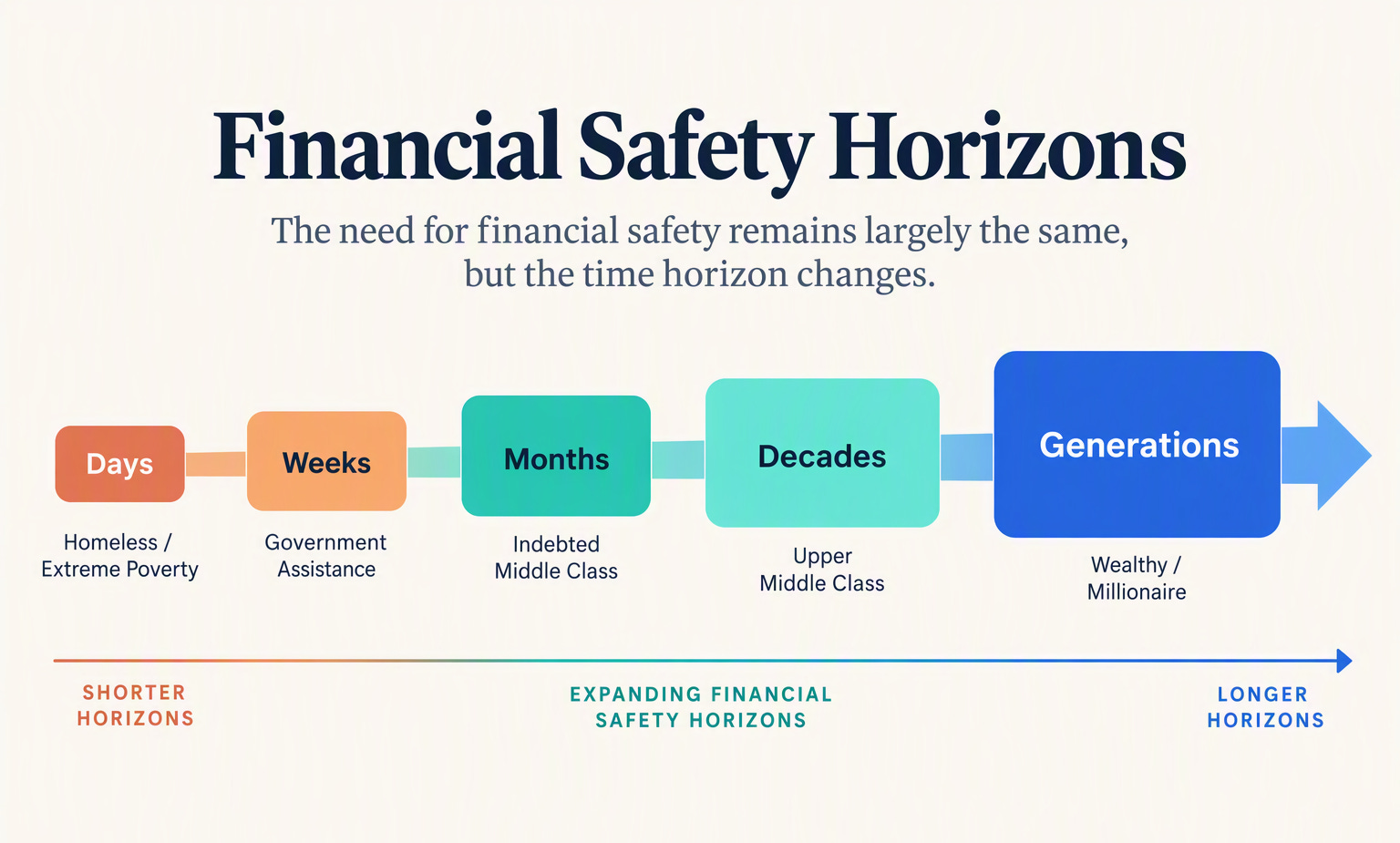
The wealth pyramid and the Hierarchy of Money are not pieces from different puzzles.
Rather, they need a connecting piece which turned out to be the concept of financial safety horizons.
The Completed Picture.
And that brings me back to the wealth pyramid that started this whole line of thinking.
Like many good diagrams, its value wasn’t in the message it was trying to communicate.
Its value was in the questions it prompted me to ask.
The wealth pyramid does not tell us which Maslow needs somebody has satisfied.
It does not tell us how happy they are.
It does not tell us whether they are flourishing.
What it may tell us is how far into the future they are financially secure enough to think.
And that insight creates a useful connection back to the Hierarchy of Money.
Because if money’s influence diminishes as we move towards growth needs, then understanding a person’s financial safety horizon may help explain why their attention is focused where it is.
Ultimately, the purpose of financial safety is not merely to create more financial safety.
At least, I don’t think it is.
The purpose of financial safety is to create the opportunity to live well.
Which leaves us with a question that feels far more interesting than the wealth pyramid ever intended to ask:
If financial safety gives us the opportunity to pursue growth, meaning and flourishing, are we actually using that opportunity wisely?