



Introduction
There are three things that you need to know about me before you read any further.
I am a pedant.
I’ve worked in finance all my life before pivoting to writing.
I grew up within a culture that holds clever analogies, subtly placed social and cultural references, plays on words and groan-inducing cheesy puns in high regard. I shall conspire to provide a high frequency stream of all these writing tools in my posts.
My pivot into writing, also came with a change in, or more precisely an additional, area of interest. See my post here which describes the impetus for this change. Since that time, I have been learning more about psychological and philosophical thinking on human wellbeing and happiness. My focus has been on trying to understand how the two areas interact and to build a bridge between the two, wellbeing and happiness with money and finance.
After exploring the subjects in depth, I found that Maslow’s hierarchy of needs framework with some interpretation and updates could provide the foundations for this bridge of understanding. The Hierarchy of Money is my attempt to use Maslow’s framework to gain a more nuanced understanding of how money affects our happiness.
Maslow’s hierarchy of needs
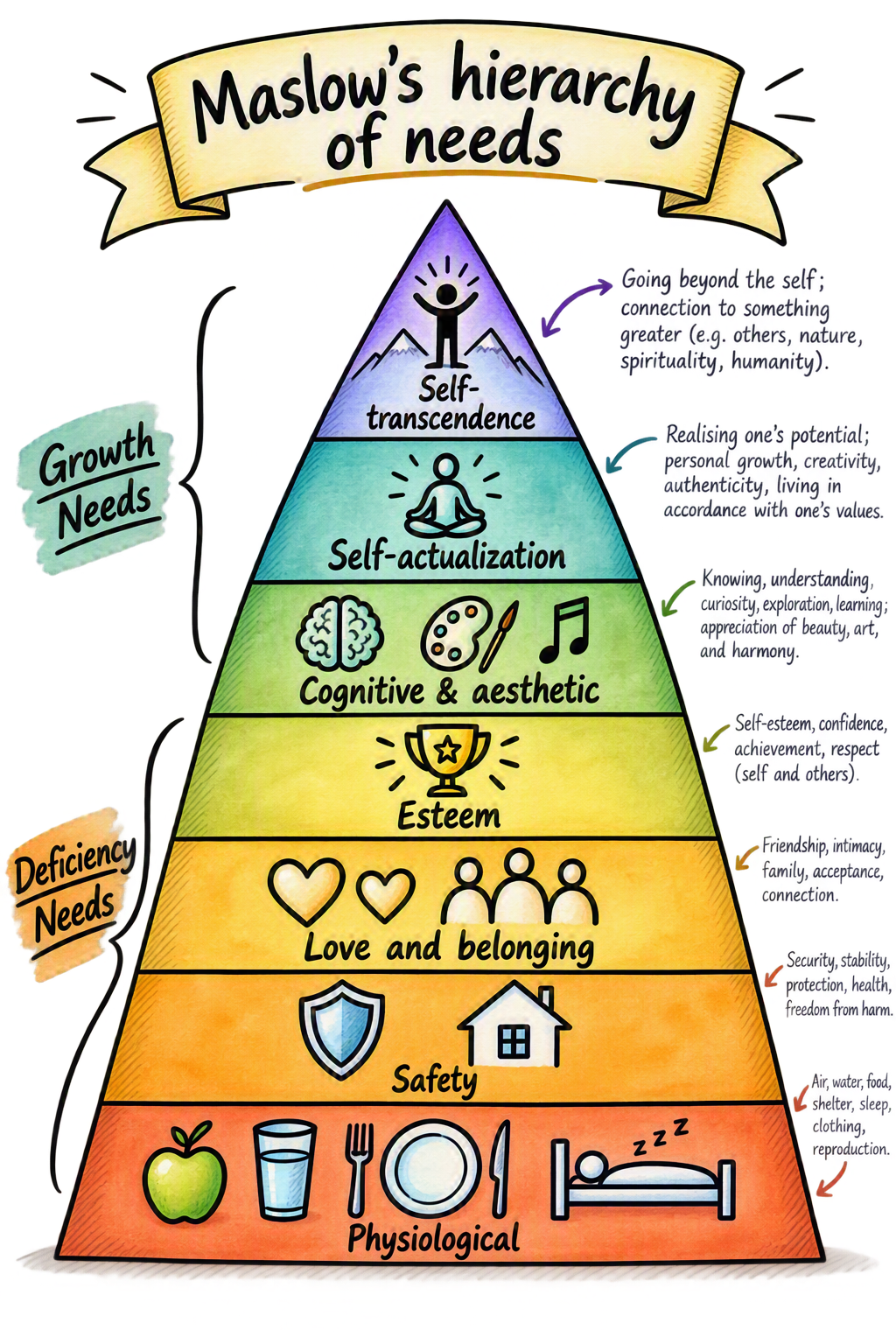
Maslow’s hierarchy of needs began as an attempt to organize what he saw as the many motives that drive human behavior into a coherent, usable framework. He first presented the idea in 1943 in a paper titled A Theory of Human Motivation and then elaborated it in the book Motivation and Personality in 1954. The model grew out of a practical question: why do people pursue some goals with urgency while other aims remain less in focus? Maslow answered this by distinguishing needs that arise from deficiency apart from needs that arise from growth, and by proposing a general ordering in which more basic requirements tend to take precedence over higher aspirations.
Development of the theory of human motivation
Maslow trained in an era when behaviorism and psychoanalysis dominated American psychology. Behaviorism emphasized observable responses to environmental contingencies, while psychoanalysis emphasized unconscious conflict and early experience. Maslow found both approaches useful but incomplete. He wanted a psychology that could account for the positive side of human life: creativity, moral insight, and the pursuit of meaning. His early empirical work on dominance and social behavior in primates provided a methodological grounding, but his intellectual shift came from studying healthy, functioning people as well as clinical cases.
The 1943 paper introduced the idea of needs arranged by relative prepotency. The idea of prepotency is that certain needs are more urgent and therefore more likely to motivate behavior until they are reasonably satisfied. Over the following decade he refined the scheme and began to describe the psychological qualities of people who had realized higher needs. By the 1960s his work had become central to what came to be called humanist psychology, a movement that emphasized human potential and the study of flourishing.
Why needs drive motivation
We are all motivated to satisfy our needs and at the heart of Maslow’s treatise is a distinction between two kinds of needs. Firstly, deficiency needs which arise from deprivation. When such needs are unmet they create a state of tension that we seek to reduce. By contrast, growth needs arise not from deficiency but rather from a desire to develop, to know, to create and to become more fully oneself. Deficiency needs produce corrective behavior and if they continuously remain unmet may lead to mental ill-health. The lowest layers of deficiency needs, physiological needs and safety needs, which are not met can lead to physical ill-health. Growth needs on the other hand produce exploratory and expressive behavior. However if growth needs remain unmet they do not produce corrective behavior or lead to pathology.
Maslow emphasized that needs are probabilistic drivers rather than deterministic laws. A person may pursue a growth project while some deficiency needs remain partially unmet. Context, culture and personality all shape how needs are prioritized. Nevertheless, the distinction between deficiency and growth needs remains a useful organizing principle for understanding why certain aims dominate behavior at particular times.
The hierarchy and its levels
Maslow’s original presentation is commonly summarized as five ascending levels. Later he discussed additional needs and refinements, but the five-level scheme is what we are still familiar with today.
Physiological needs - These are the most basic biological requirements for human survival. Examples include food, water, sleep, warmth, breathing. In practical terms, a person who is hungry, exhausted or ill will typically prioritize obtaining food, rest or medical attention before pursuing other aims. Physiological needs are deficiency needs. Their absence produces urgent, corrective behavior. Though not considered by Maslow, in the context of a lifetime, good-health is an important physiological need.
Safety needs - Once physiological needs are reasonably met, concerns about safety and stability become salient. Examples include secure housing, predictable income, physical safety, access to health services, and protection from violence or environmental hazards. Employment that provides a steady wage, a tenancy agreement that guarantees housing for a period, or a neighborhood with low crime are all instances of safety needs being satisfied. Safety needs are deficiency needs. When safety is threatened, people often withdraw from exploratory or creative pursuits and focus on restoring security.
The need for love and the sense of belonging - This level covers social connection and affiliation. Examples include close friendships, intimate partnerships, family bonds, membership of social groups, and a sense of acceptance at work or in the community. A person who lacks meaningful relationships may experience loneliness and will often prioritise forming attachments. Love and belonging are deficiency needs in Maslow’s account because their absence creates a felt lack that people seek to remedy.
Esteem needs - Esteem needs concern self-respect and recognition from others. They include feelings of competence, achievement, status and the respect of peers. Examples are professional recognition, promotions, awards and the internal sense of efficacy that comes from competence. Esteem needs are classed as deficiency needs when they take the form of seeking external validation to avoid feelings of inferiority. They can also shade into growth needs when the pursuit of mastery becomes an end in itself rather than a means to shore up self-worth.
The need for self-actualization - At the top of the original five level scheme is self-actualization, the realisation of one’s capacities, to become everything that one is capable of becoming. Examples include a scientist devoted to discovery, an artist committed to a lifetime of work, a teacher who continually refines their craft, or a community leader who pursues social justice. Self-actualization is a growth need. It does not arise from lack but from an impulse to develop, to express, and to become more fully oneself. Maslow described self-actualization as a process rather than a fixed state. It involves authenticity, creativity, autonomy and a sense of purpose.
Later additions: Cognitive and aesthetic needs, and self-transcendence. Maslow later identified additional cognitive and aesthetic needs that he did not definitively position within the hierarchy, but arguably sit between esteem and self-actualization. Cognitive needs refer to the desire to know, to understand and to make sense of the world. Examples include intellectual curiosity, scientific inquiry and philosophical reflection. Aesthetic needs concern the appreciation of beauty, balance and form, as when a person seeks art, music or harmonious environments. Both cognitive and aesthetic needs are growth orientated.
Maslow also proposed self-transcendence as an additional growth need. Self-transcendence involves moving beyond personal fulfilment toward concern for others, for causes, or for a sense of unity with something larger than the self. Examples include deep religious or spiritual commitment, altruistic service, or creative work that aims to benefit humanity. Self-transcendence is a growth need that reorientates motivation from the self to the broader world.
How do we reach a definition of happiness from Maslow?
Before setting out our hierarchy of money, we first turn to the question: What is happiness? Here we find that the answer is that happiness, or alternatively wellbeing (being the more contemporary synonymous term), comes in two flavors; hedonia and eudaimonia.
Hedonia, from the Greek concept hêdonê (meaning pleasure). Hedonia is a happiness we derive from the way that we feel. Feeling good (pleasure), but also from not feeling bad (discomfort). It is short lived sensory experience and fades quickly. Psychologists usually discuss hedonia in terms of experiences, focusing on fulfilling desires and seeking pleasure, and having the presence of positive affects (feelings) and the absence of negative ones.
Eudaimonia, from the Greek words eû (meaning good/well) and daímōn (meaning spirit/deity). Not being a word being commonly adopted into English use (like hedonia/hedonism), eudaimonia, literally translated as good spirit, is also commonly known as flourishing. Maslow’s growth needs (cognitive and aesthetic needs, self-actualization, and self-transcendence) feed into eudaimonia. In a state of eudaimonia, a person has meaning, long-term personal growth and moral excellence. A person satisfying Maslow’s growth needs is likely to be flourishing.
Hedonia is derived from the way that we feel, whereas eudaimonia is more derived from who we are when we are flourishing.
Both flavors, as their names indicate are concepts which have been around for millennia, being at least as old as the Greek philosophers Epicurious and Aristotle who discussed them in their work.
The study of wellbeing has not reached an agreement on how hedonia and eudaimonia work in providing us or depriving us of happiness. However psychologists do agree that both hedonia and eudaimonia are important components of the human condition that are required to promote wellbeing.
How do we incorporate money into the framework?
Money as a means, not an end.
“Money is the purest example of the tool... It is an institution in which the individual thing or enterprise completely loses its own significance and finds it only in the transition to something else.” Georg Simmel (The Philosophy of Money)
Ask someone what they would wish for if they encountered a genie who granted them one wish, and there is a reasonable chance that they would wish for riches, a billion dollars or a swimming pool filled with gold coins that they would jump into, in homage a well-known fictional miserly duck. Ask them why they would make such a wish, and they will tell you that their newfound wealth would help them realize what they actually desired. Perhaps it would buy them their dream house, allow them to quit their job, buy a luxury yacht, or simply buy them happiness.
What about in real life?
If you tell someone that you are going to give them $1,000,000 and ask what they would do with it, perhaps they will tell you that they would pay off the mortgage on their house, take a round-the-world cruise, give money to charity, give gifts to their family.
If you tell someone you are going to give them $10,000 and ask they would do with it,
perhaps they will tell you that they will pay off their auto-loan, put it towards their children’s college tuition fund, or take a dream holiday.
If you tell someone you are going to give them $100 and ask what they would do with it,
perhaps they will say they will spend it on a nice meal or place a bet on a horse.
We are all familiar with these questions (and answers), as we have all seen them being asked and answered. Among all quiz shows and gameshows, asking contestants what they will do with the money that they might win on the show is the most common question in history.
What is common among all these situations is that no matter how much money is being considered, we are not wishing for the money itself. We don’t say that we will just hold on to the money purely for our love of it. We all have a use for it, what we can buy with it, or what utility it can bring us. Even if we don’t have an immediate use for it, we would say that we are saving it, for a rainy day, for retirement, for our heirs to inherit.
Although some may say that they desire money for money’s sake, it is not borne out by general experience and academics have not proposed money to be a direct human need. Money is a means to an end. It is a tool that we use to satisfy our desires and our needs.
Therefore, we do not add money as a need within the hierarchy, however we might consider that financial safety be added as a safety need. Instead, we recognise that money can be used to purchase commodities which will help us in our pursuit to satisfy needs within hierarchy.
The hierarchy of money
The hierarchy of money comprises three rules about the hierarchy of needs, the types of happiness, and money’s influences on the two.
In deriving these rules, we make use of the following arguments related to the hierarchy of needs and the discussion about hedonia and eudaimonia and the role of money in satisfying our desires.
In General, we will satisfy lower-level needs on the hierarchy (deficiency needs), before having the motivation to satisfy higher level needs (growth needs).
Satisfying growth needs are linked to eudaimonia / flourishing.
Hedonic experience not required / less likely to occur when engaged with satisfying growth needs.
Hedonic experience can be integrated into / more likely to occur when engaged with satisfying deficiency needs.
In a modern society, money is needed to satisfy lower-level needs and very likely to be able to buy commodities to satisfy deficiency needs.
Money is less essential to satisfy higher-level needs and unlikely to be able to buy commodities to satisfy growth needs.
Rule 1. The hierarchy of needs reflects a spectrum of hedonic-eudaimonic experience
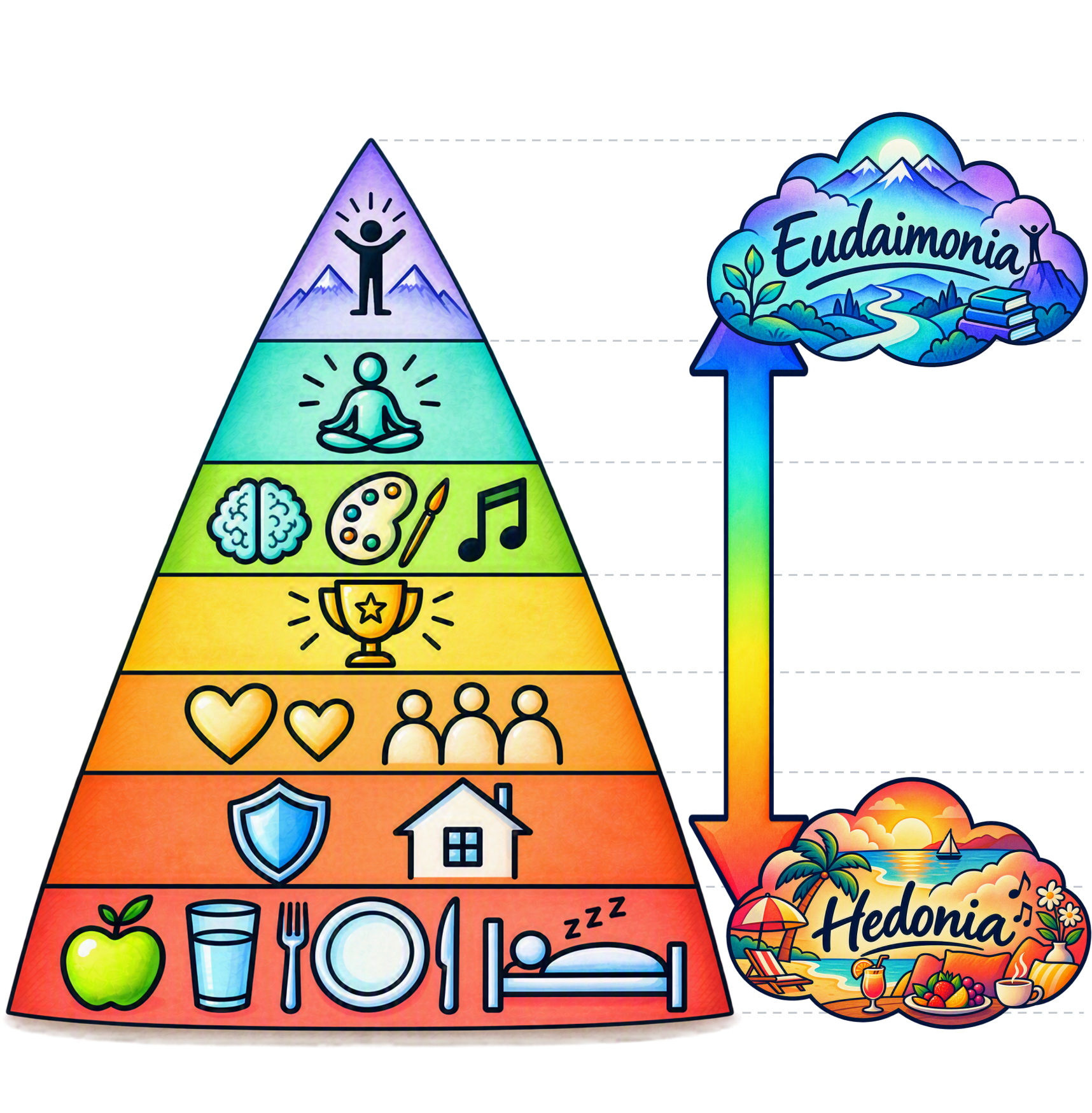
Rule 1 does not say that when satisfying low-level needs, hedonia is experienced as a consequence; or that when satisfying high-level needs, eudaimonia is experienced as a consequence. Rather we are saying that satisfying higher-level growth needs is indicative of someone experiencing eudaimonia.
At the other end of the spectrum, we are saying that, if a person is engaging in hedonia inducing activities (pleasurable ones), they are more likely to be activities that are satisfying deficiency needs. When we think of hedonia and pleasurable activities, we think of physical pleasures like eating good food, being safely tucked up under a warm blanket when it is cold outside, or having fun with friends and loved ones. These activities are not required to satisfy the relevant needs, but in general, we observe that hedonic, pleasurable activities are linked to the lower-level needs.
By contrast, when we are seeking eudaimonia, the types of activities we are engaged with are not necessarily pleasurable, but rather engaging or challenging. The flow-state that we reach when fully locked-in to a task is associated with neutral affect and is considered eudaimonia enhancing.
We suggest that there is a spectrum of hedonic-eudaimonic experience as scientists treat the two as compatible and interconnected. The fulfillment of eudaimonic functioning (like achieving a meaningful goal or personal growth) inherently feeds back into hedonic experiences (joy, positive affect, and life satisfaction). Conversely, hedonic replenishment (comfort, emotional stability) provides the psychological safety net and energy required to pursue eudaimonic challenges. Certain deficiency needs will be satisfied by engaging in actions that are eudaimonic. For example we might gain esteem from having mastered a craft or skill, but at the same time personal mastery is an indicator for eudaimonia. Relatedness is another eudaimonia indicator which, if achieved, would go towards satisfying the need for love and belonging.
Rule 2. Money has a stronger influence on satisfying lower-level needs than higher-level needs
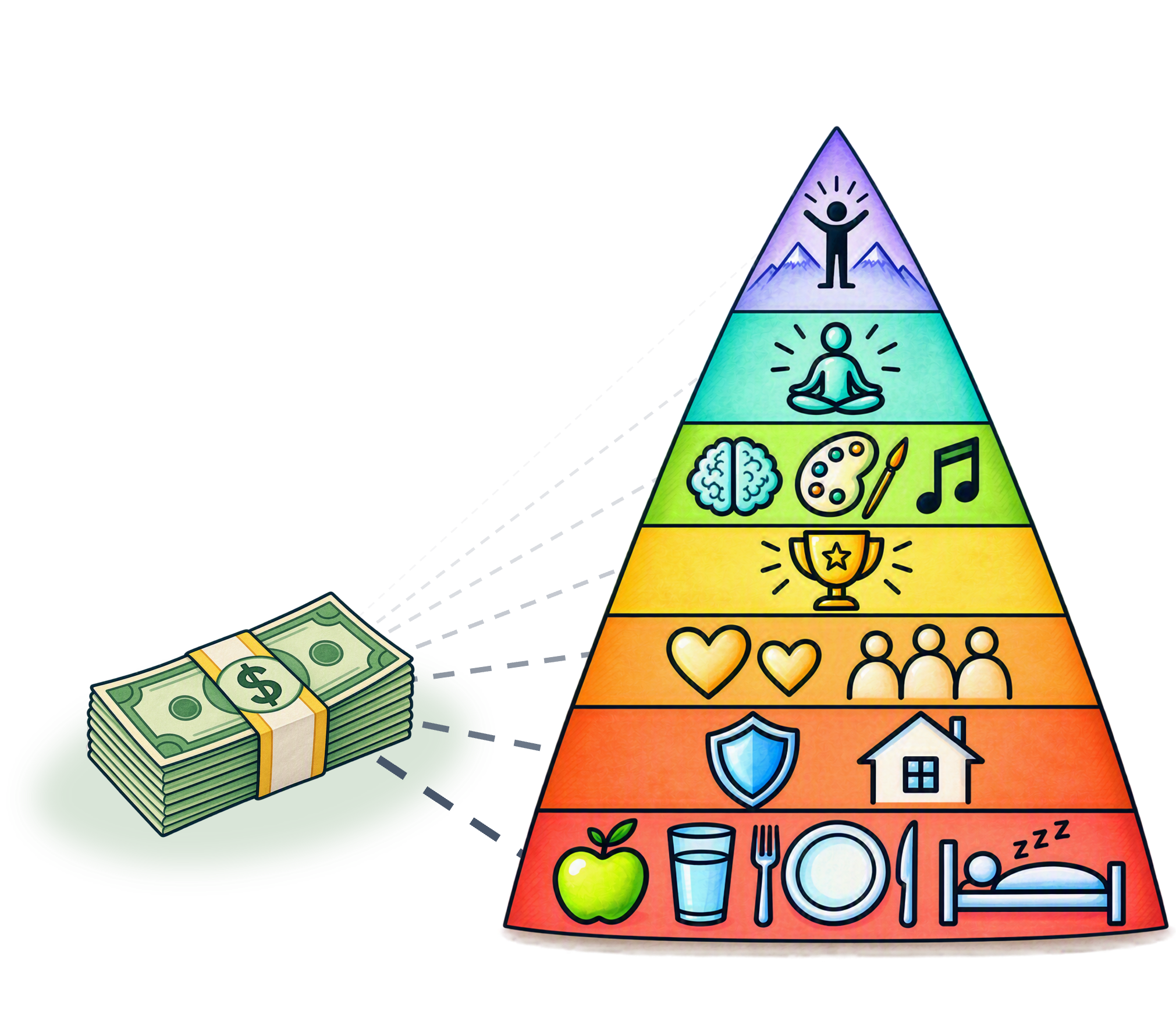
Rule 2 says that money can buy you what you need to have a meal to eat, get a night’s sleep, have a warm and safe shelter. It is important in supporting efforts to maintain friendships and family relationships and raising a family. It is even likely to buy items; clothing, car, holidays which may support your esteem needs. However in satisfying growth needs, money is not an important contributory factor and is unlikely to influence efforts to find meaning and mastery which are elements that psychologists find necessary to achieve eudaimonia.
This relationship was commented on by C. McDermind, the first to publish a visualization of the hierarchy in a layered pyramid, in an article in Business Horizons journal in 1960. In his article, How Money Motivates Men, he writes:
“Obviously, the first meaning of money lies in its power to buy satisfaction of the basic physiological needs-food, clothing, and shelter…
…Next in the hierarchy of needs is the category termed safety, a major expression of which, in today’s culture, is the need for financial security. Here money represents insurance against physiological deprivation and against the financial hazards of poor health…
…Money can also facilitate satisfaction of the social needs, the third level in the hierarchy, but only indirectly. Thus one can purchase membership in a country club, but the actual exchange of friendship and love does not necessarily result…
…The situation is different in the ease of the esteem needs..
…What about self-realization at the peak on the need pyramid? Money is of little importance in gaining fulfillment at this level; it can do no more than remove obstacles to self-realization.”
Rule 3. Money has a decreasing influence along the spectrum of hedonic-eudaimonic experience
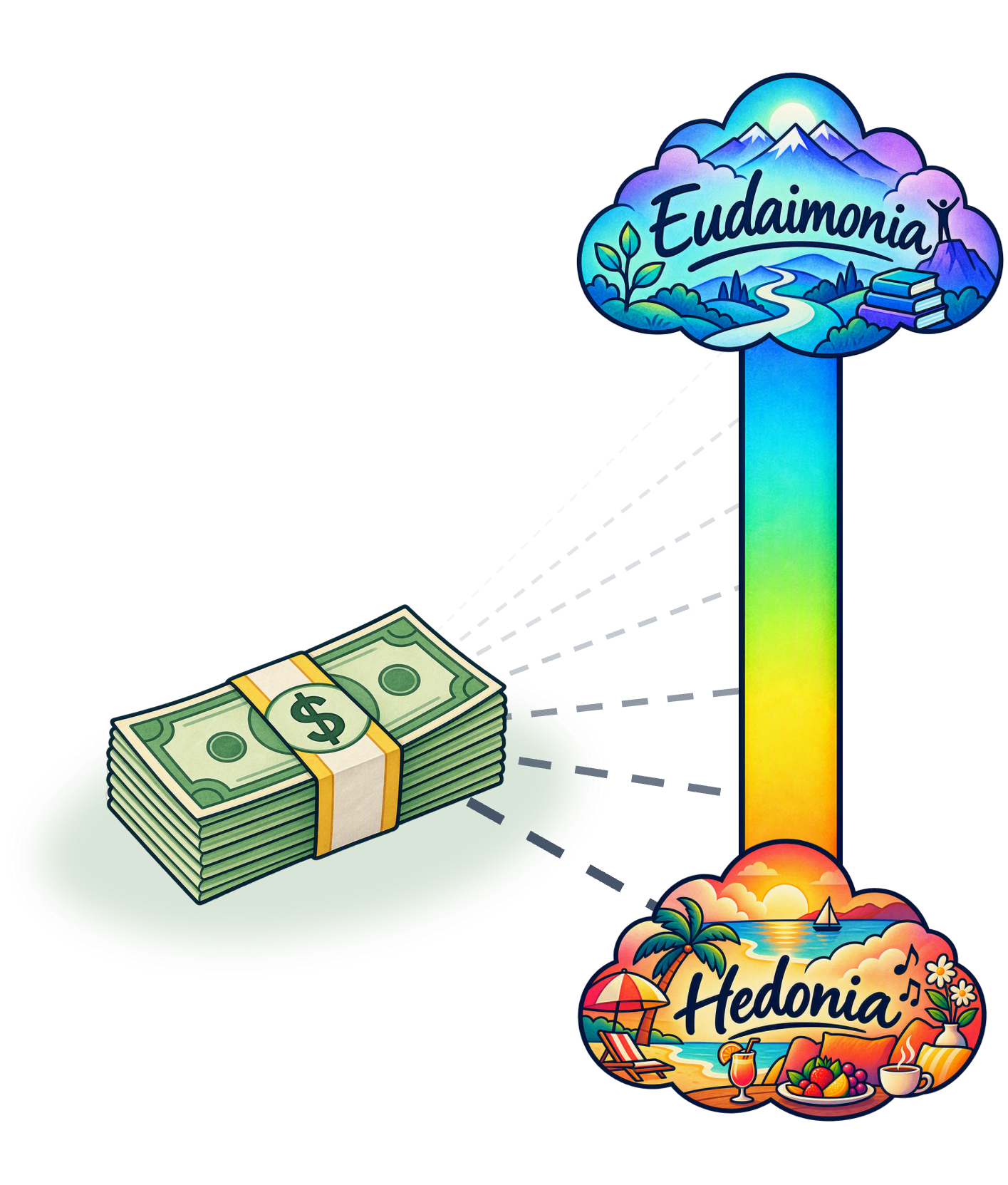
Rule 3 says that money is perfectly able to buy us the small pleasures in life, and the large ones too. However it has very little ability, if any, to directly buy us self-actualization, or meaning in our lives, or commodities which we will use to achieve a state of eudaimonia.
Rule 3 is implied by rules 1 and 2 and all three rules are implied by a combination of the other two. So I only need to convince you of any two, and the third follows!
So the upshot of these three rules is that we can consolidate our hierarchy of money framework into a single visual representation.
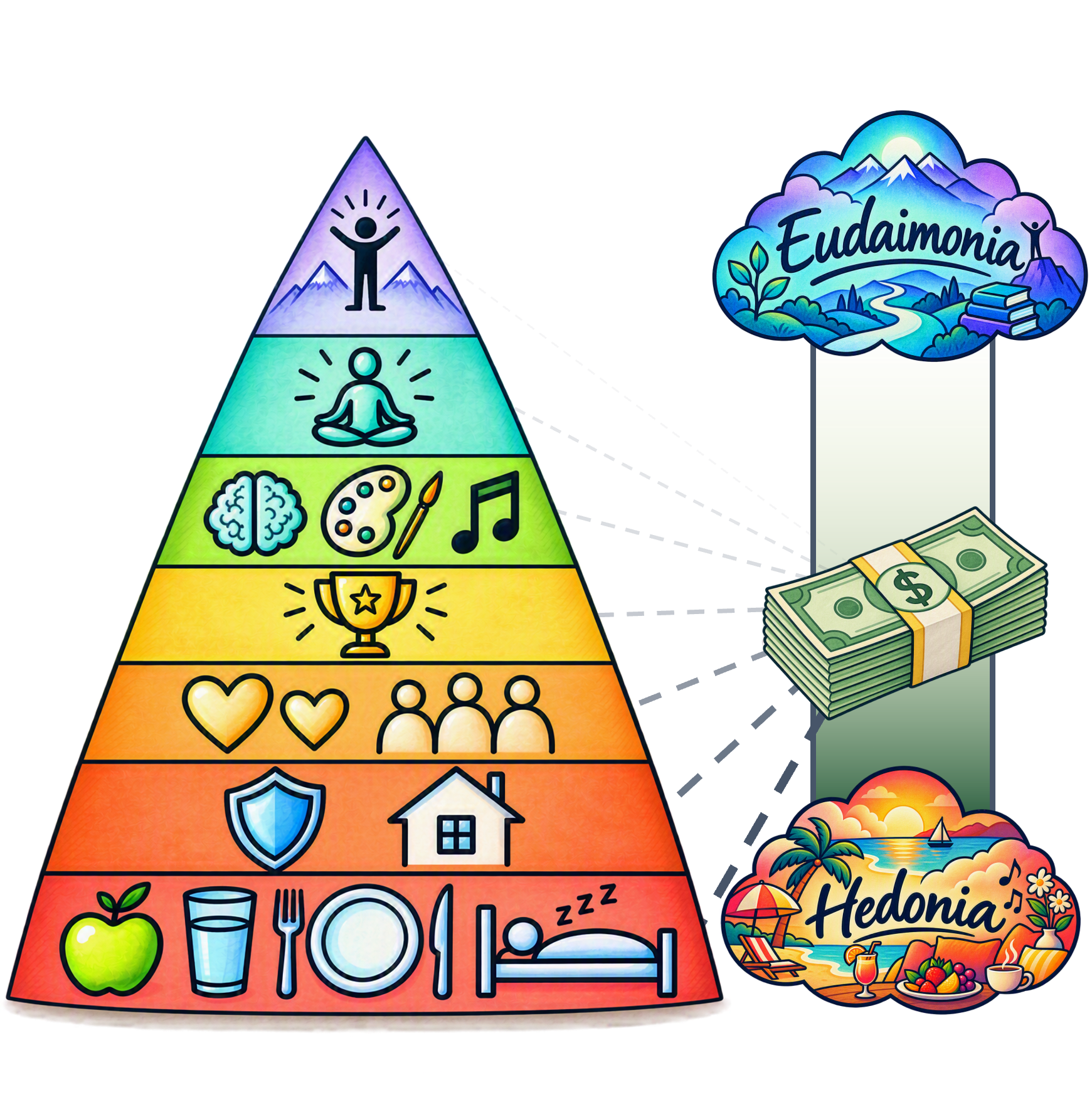
The hierarchy of money provides us with a single framework that integrates a need hierarchy (capturing both physical and psychological needs), the place of hedonic and eudaimonic experience and the influence of money.
If you are still with me, then well done. This post was intentionally long as this hierarchy of money concept is something that I feel is very useful to set out how we can think about the ‘balance of money and happiness,’ for the want of a better phrase, in a structured framework.
What this framework and the ideas that we have discussed above would say is: “Yes, money does buy happiness, but only if you are willing to be satisfied with hedonia centered happiness.” It’s commonly said that “money can’t buy you true happiness,” perhaps we can think of that as meaning that money can buy you all the pleasures that you could wish for, but it would not provide you with a fulfilled life of flourishing.
In the above case, we are considering that money is in limitless supply. In the real world, where many of us are struggling earn enough money to meet even our basic needs, how should we be allocating our scarce resources? Future posts will discuss topics like these. This hierarchy of money framework provides a scaffolding around our discussion.