


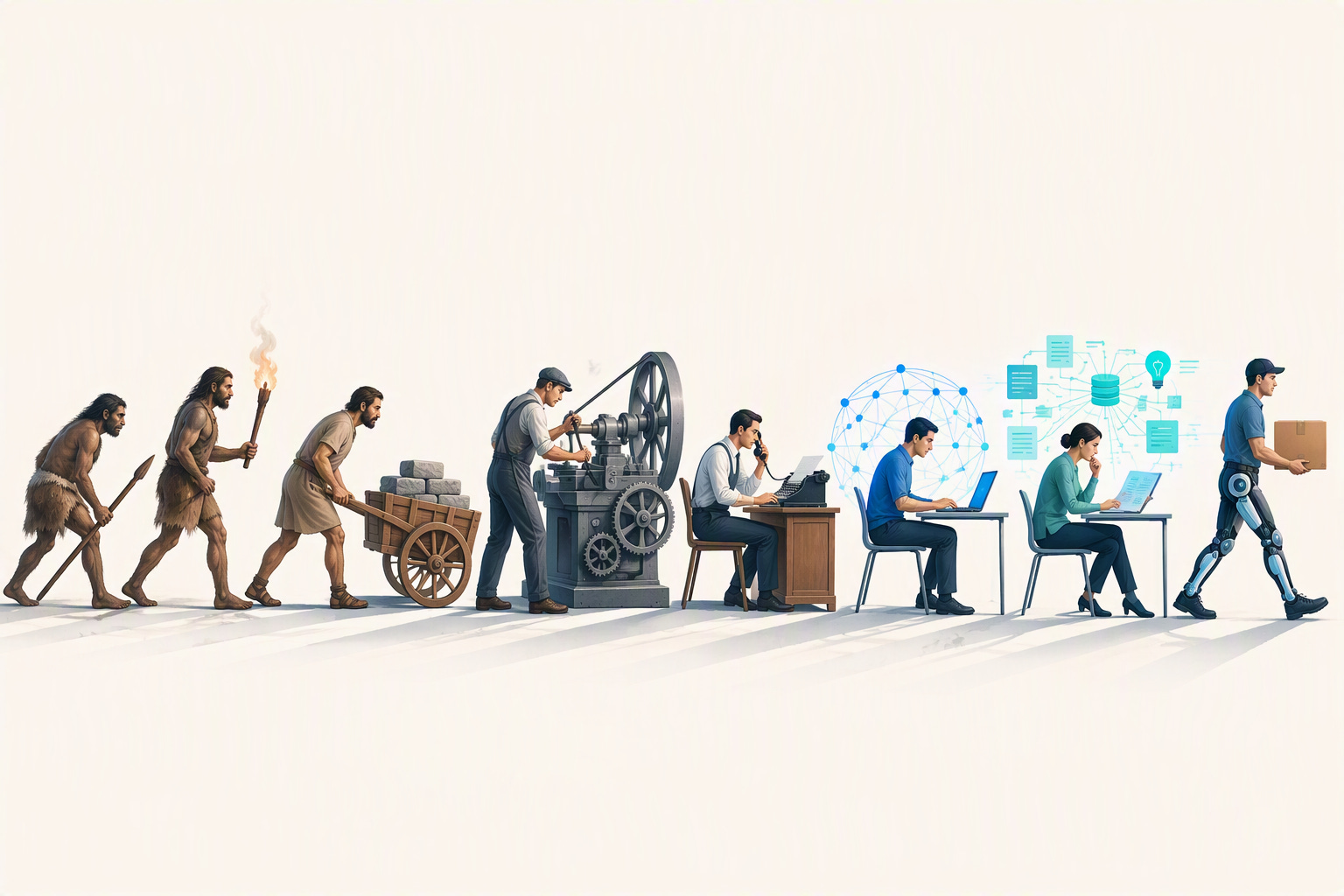
When I was learning about the financial services industry in the late 1990s, I encountered a word that seemed almost purpose-built to make a simple idea sound complicated. That word was disintermediation.
It was the kind of word that felt perfectly at home in a business school lecture. Long, unattractive, yet perfectly functional and difficult to work into ordinary conversation. If I had to try, “removing the middleman” would probably have conveyed the idea rather more efficiently.
At the time, disintermediation was presented as a threat to banks. Banks sat between people with money and people who need it. They were financial intermediaries. Deregulation and technology were beginning to change traditional banking practices, creating new ways for savers and borrowers to connect without relying so heavily on banks. Banks were at risk of becoming disintermediated. When savers or investors found more direct routes to borrowers and investments, the bank’s intermediary role was reduced.
It seemed important, but specialized.
Three decades later, the word I believe deserves a long-awaited comeback.
Travel agents once mediated between travelers and airlines or hotels. Stockbrokers sat between investors and the financial markets. Bank employees sat between customers and basic financial transactions. Supermarket cashiers sat between shoppers and the completion of a purchase. Newspapers, publishers and broadcasters sat between information and its audience.
Many of those intermediaries still exist, but relationships have changed. Technology has allowed us to bypass them, use them less frequently, or reserve them for situations where they add more value.
Now artificial intelligence is bringing the same process to a different category of intermediary: the expert.
Lawyers, accountants, consultants, analysts and other knowledge workers have traditionally stood between complicated bodies of knowledge and the people who need to use them. AI is beginning to provide another route.
What if this obscure idea I learnt about in banking thirty years ago turns out to be one of the most important forces shaping how we live and work today, and in our immediate futures?
Removing the Middleman
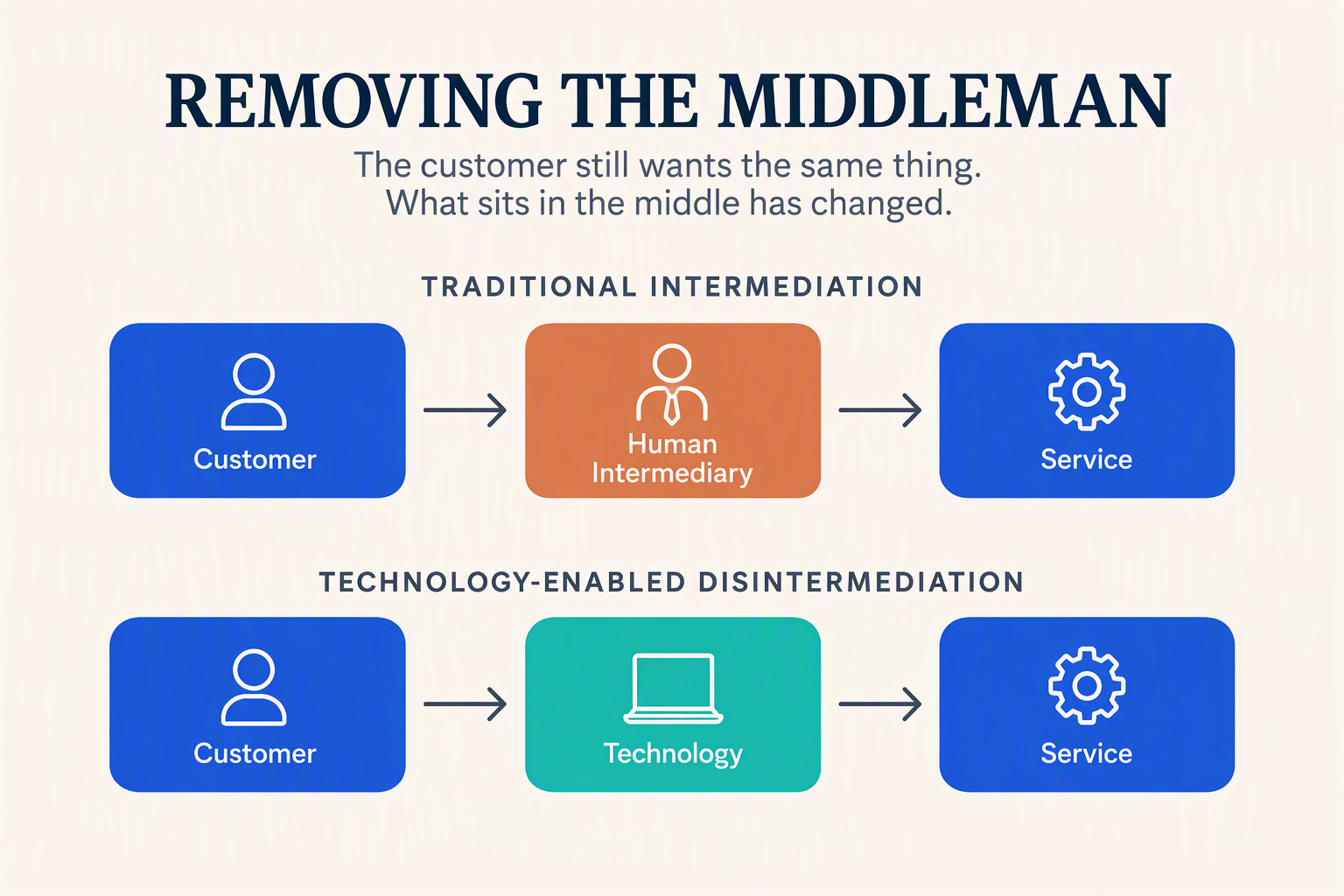
Disintermediation is usually translated as removing the middleman.
That is accurate, but it can also be misleading. It makes the middleman sound like an unnecessary obstacle who somehow inserted themselves into a transaction and began charging for the privilege.
Most intermediaries exist for good reasons.
They may provide access to a market, identify suitable products, compare alternatives, verify information, coordinate transactions, manage risk or supply expertise. They may also create trust between parties that do not know each other and would struggle to transact directly.
A travel agent once did more than hand over an airline ticket. The agent collected information that ordinary travellers could not easily access, understood reservation systems, compared routes, coordinated accommodation and dealt with changes when something went wrong.
A stockbroker once offered more than the ability to place an order. The broker had access to the market, understood its procedures, possessed information not readily available to the public and provided a human point of trust.
An intermediary remains economically valuable when the value of those services exceeds the cost, delay or friction created by occupying the middle.
Technology changes that calculation.
If a new system gives customers the information, access or execution capability they previously lacked, they no longer need the intermediary for every step. The intermediary’s institution may remain, but its role within the transaction changes.
This produces an important distinction:
Removing The Intermediary Does Not Remove The Function Previously Performed By The Intermediary.
The work still has to be done. Someone must search the flight schedules, compare the hotels, place the investment order or scan the groceries. Technology often transfers part of that work to a digital system and part of it to the customer.
Disintermediation does not always create a genuinely direct relationship. Often it replaces one intermediary with another. The travel agent gives way to a booking platform. The local bookseller gives way to an online marketplace. The bank employee gives way to an app.
This is sometimes called reintermediation. Think of Uber, Uber Eats or Airbnb. The old middleman disappears, shrinks or changes role, while a new form of middleman takes its place.
It Started with the Banks
The word arose in finance because banking makes the intermediary particularly visible.
In the traditional model, savers deposit money with a bank. The bank uses those funds, together with other sources of finance, to lend to households and businesses. It performs several useful functions along the way, including assessing borrowers, managing liquidity, pooling risk and transforming large numbers of deposits into loans.
In its simplified form, the relationship looks like this:
Savers → Bank → Borrowers
The saver does not need to find a business that needs a loan. The business does not need to identify hundreds of individual savers and negotiate separate agreements with each of them. The bank sits in the middle and makes the system workable.
Financial disintermediation occurs when money moves by a route that reduces reliance on that traditional bank relationship. Investors might purchase securities issued by a company rather than leave money in a bank deposit that ultimately supports bank lending. Companies might raise capital from financial markets rather than relying primarily on bank loans.
None of this means that the intermediary’s functions vanish. Direct investors still require information, contracts, payment systems, risk assessment, custody and access to markets. What first appears to be a direct transaction usually depends upon an extensive supporting infrastructure.
This is why disintermediation is rarely as simple as drawing a line through one box in a diagram.
Banks themselves illustrate the point. Capital markets and new financial technologies can reduce reliance on traditional bank lending, but banks can adapt, participate in those markets, provide adjacent services and develop new forms of intermediation.
Finance gave us the vocabulary because banks made the middleman easy to see.
But the underlying pattern was much bigger.
Disintermediation Everywhere
Disintermediation didn’t stop with banking. Fintech and cryptocurrencies provide more recent financial examples, but the underlying phenomenon has spread far beyond finance. It is everywhere.
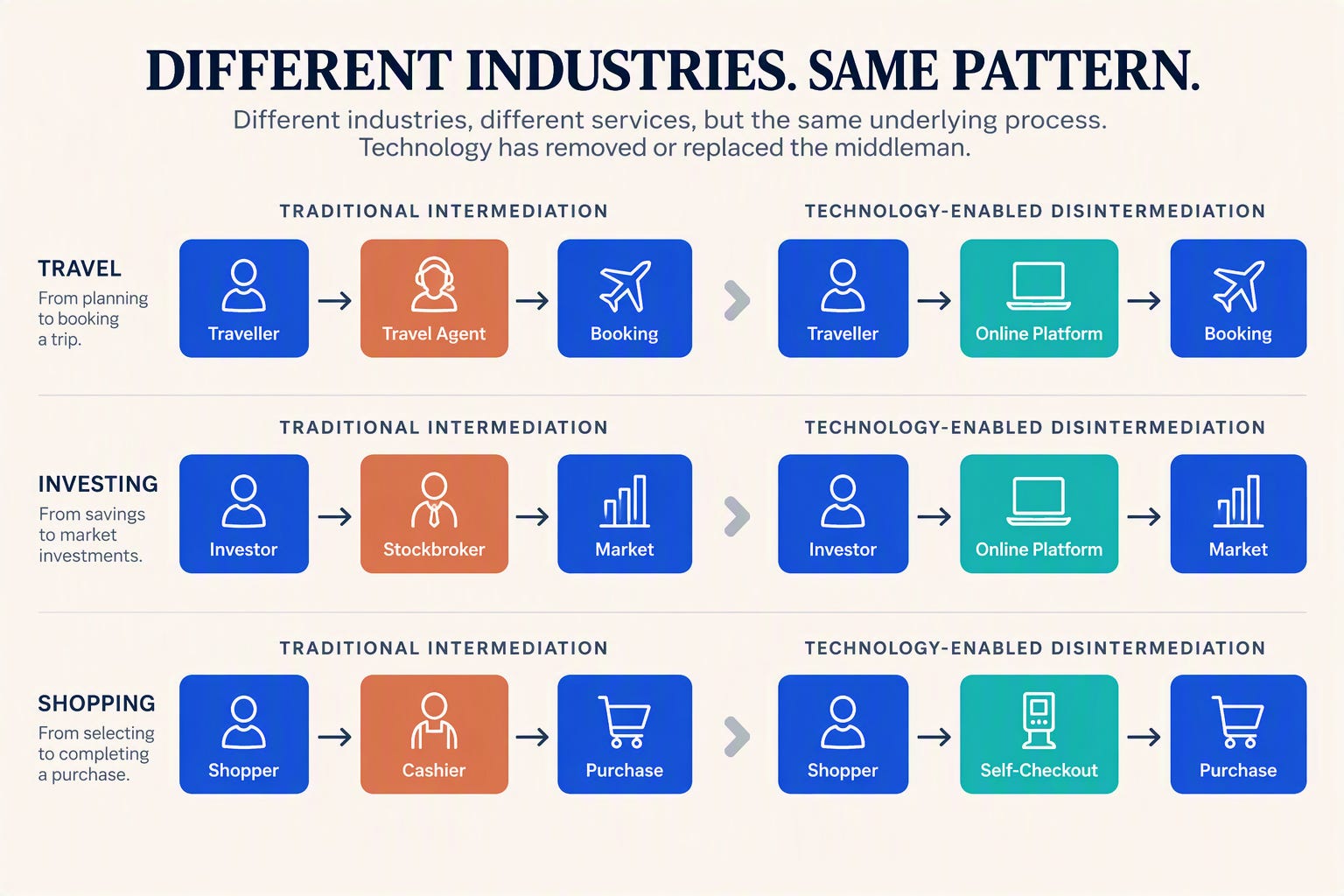
Consider travel. A travel agent once sat between the traveler and the airline or hotel because the agent had access to information and reservation systems that were awkward for customers to use directly. The internet put search, comparison and booking tools into the customer’s hands. The holiday was not disintermediated. Access to it was.
Retail shows how the same process can happen gradually. Counter service gave way to self-service; staffed checkouts were supplemented by self-checkout; scan-and-go moved another part of the transaction to the customer and technology. Disintermediation often happens task by task, not through an occupation disappearing overnight.
Investing followed a similar path. Online platforms made research and execution directly accessible to individual investors, reducing reliance on the traditional stockbroker for routine transactions. Search engines and digital publishing did something comparable to traditional information gatekeepers. In each case, the underlying function remained, but who performed it changed.
For consumers, the attraction is obvious: lower cost, greater choice, more control and easier access. But consumer convenience and worker disruption can be two sides of the same technological change. What increases our freedom as customers can reduce the economic value of work that once supported someone else’s income and financial security.
We’ve Seen This Movie Before
Across these examples, two questions expose the recurring mechanism.
What did the intermediary know, own or do that I couldn’t conveniently do myself?
Then:
What happens when technology gives me that capability?
An intermediary’s economic value often rests upon some form of scarcity. Information may be difficult to obtain. Access may be restricted. Execution may require specialized infrastructure. Expertise may take years to develop. Trust may depend upon a recognized institution or regulated professional.
Technology changes economic relationships when it reduces that scarcity.
The result is not always elimination. Some intermediaries disappear, but others move towards more valuable or complicated work. Some combine expertise with the new tools. Some retain their role because people still value reassurance, accountability or convenience.
New intermediaries appear as well. Digital platforms may begin by connecting customers directly with providers, then become powerful gatekeepers in their own right.
Disintermediation is therefore less a story about a world with no middlemen than a story about continual movement. Functions are separated from the people and institutions that historically performed them. Customers acquire new capabilities. Former intermediaries adapt, specialize or lose relevance. New ones emerge.
Technology repeatedly changes who, or what, sits in the middle.
Now Comes AI: Disintermediation on Steroids
Artificial intelligence extends this familiar process into less familiar territory.
Previous waves of consumer technology frequently reduced the scarcity of access, distribution, transaction execution or information retrieval. AI increasingly reaches into knowledge, analysis, explanation, drafting, interpretation, planning and decision support.
In other words, it moves into expertise.
That does not mean that AI is about to eliminate entire professions. The usual questions are too blunt: Will AI replace lawyers? Will it replace accountants?
A profession is not one indivisible activity. It is a collection of tasks, responsibilities, relationships and regulated obligations. A lawyer may research law, interpret facts, draft documents, negotiate, advise, represent a client, exercise judgement and accept professional responsibility. An accountant may collect information, classify transactions, apply rules, test assumptions, prepare reports, explain results and sign off work.
AI does not affect all these functions equally.
Which functions performed by lawyers, accountants and other professionals still require the professional to sit between the client and the desired outcome?
Consider legal services. A person seeking an initial explanation of a common legal concept may previously have had three realistic options: consult a lawyer, find a suitable legal reference, or search online and attempt to sort reliable information from everything else.
A conversational AI system offers another route. It can explain terminology, organize questions, summarize supplied material and produce a first draft. That does not make the output regulated legal advice. It may be incomplete, inaccurate or inappropriate to the person’s jurisdiction and circumstances. But it changes what can be done before a lawyer becomes involved.
The same applies to accounting. AI can help organize information, explain concepts, identify potential issues and prepare preliminary analysis. It does not automatically possess the context, verification, judgement or accountability required for high-stakes professional work. But it may reduce the amount of professional intermediation needed for routine steps.
This is already more than a theoretical possibility. A 2026 Thomson Reuters survey of more than 1,500 professionals across legal, tax, accounting, risk, fraud and government found that 40% said their organizations were using generative AI, up from 22% the previous year. More than 80% of current users engaged with it weekly, although only 18% said their organizations tracked return on investment.
Those findings do not tell us how many jobs AI will create or remove. They show that the technology is moving into professional workflows before its long-term economic effects are clear.
The key point is not that every client will dispense with professional help. It is that the boundary between what the client can do directly and what requires an expert may move.
Clients may arrive with more information, better organized questions and AI-generated drafts. Professionals may spend less time producing routine material and more time checking outputs, handling unusual cases, applying judgement and taking responsibility.
That could reduce the demand for some forms of work while increasing the value of others.
It may also broaden access.
Professional expertise is expensive partly because it is scarce. Developing it takes education, training and experience. Delivering it through a professional organization adds further costs. Many households and small businesses therefore receive less advice than they would ideally want, not because advice has no value, but because the cost is difficult to justify.
AI can make parts of that expertise available at very low marginal cost.
This is the consumer side of the Great Disintermediation. Online booking gave individuals capabilities once concentrated in travel agencies. Investment platforms gave individuals capabilities once concentrated among brokers. AI may give individuals access to portions of knowledge and analysis previously concentrated within professional firms.
It would be strange to discuss this only as a threat.
A small business that cannot afford regular professional support may use AI to organize its records or prepare questions before consulting an accountant. Someone facing a legal problem may gain enough preliminary understanding to recognize that specialist advice is needed. A patient may be better equipped to understand medical terminology or prepare for a consultation.
There is another consequence hiding inside this. Knowledge, education and specialist guidance have always had a financial cost. AI can reduce that cost dramatically. The ability to learn about an unfamiliar subject, develop a new skill, explore an idea or obtain some forms of expert assistance is becoming available to people who might previously have been priced out.
That matters beyond productivity. Some of the things that help us grow as people, learning, developing competence, exercising creativity and pursuing our interests, may themselves become easier to access.
The limitations matter. So do the benefits.
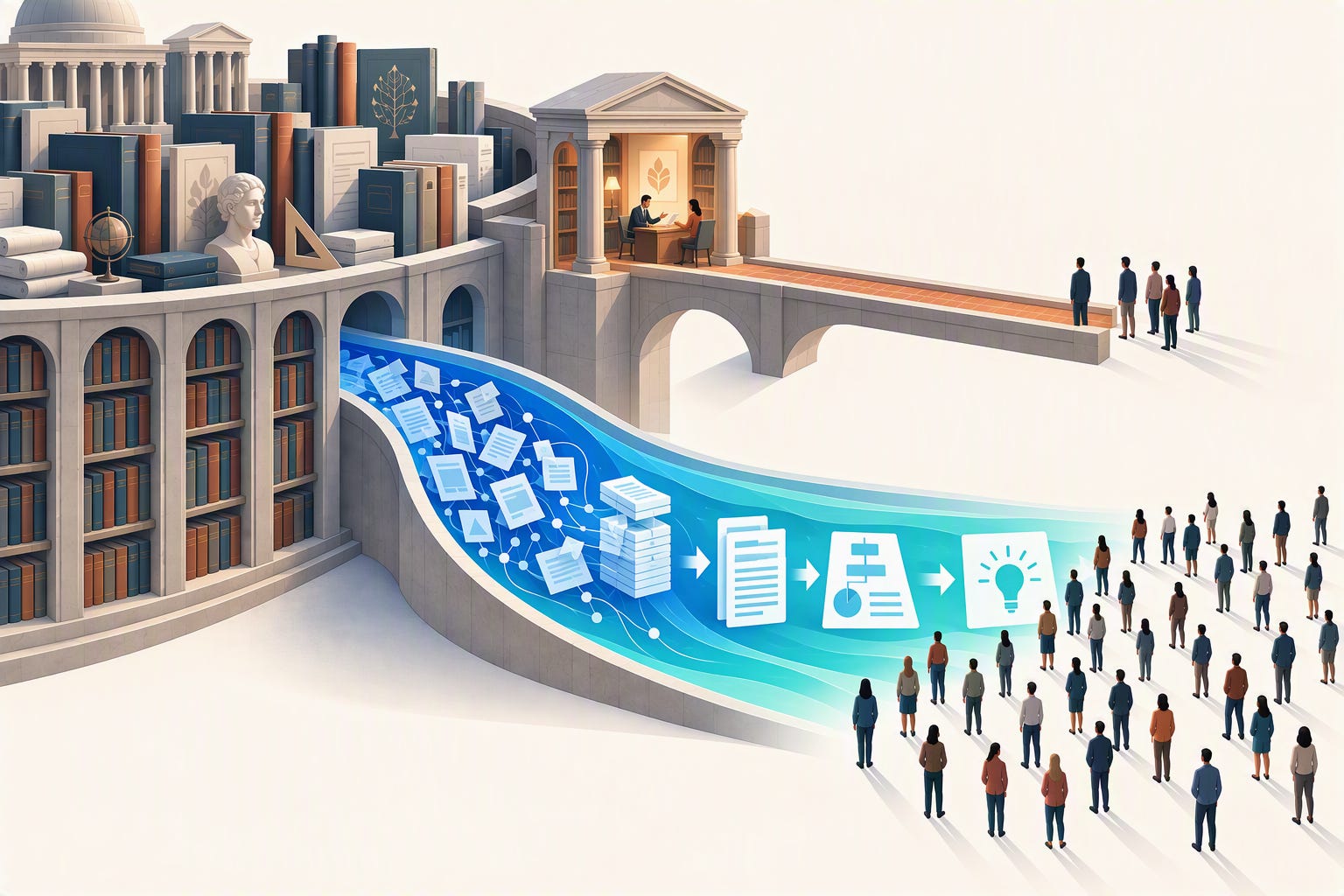
The professional intermediary does not necessarily disappear. The expertise bottleneck widens.
More people can reach useful knowledge directly, while regulated professionals remain important where accuracy, verification, confidentiality, judgement and accountability are essential.
Healthcare makes these boundaries particularly clear.
The World Health Organization identifies potential uses of large multimodal AI models in areas including diagnosis and clinical care, patient-guided use, clerical and administrative work, education, and research and drug development. Its guidance also highlights risks including false, inaccurate, biased or incomplete outputs, reinforcing the need for governance and safeguards.
In the UK, the National Commission into the Regulation of AI in Healthcare has focused on issues including accountability, transparency, clinical practice, organizational governance and system-wide assurance.
That is because cognitive support and physical care are not the same thing.
AI may help retrieve information, monitor data, explain terminology, support triage or suggest analytical possibilities. It cannot thereby perform a physical examination, carry out a procedure, provide hands-on care or accept clinical responsibility for a decision.
Professional work raises another, less visible problem.
Junior lawyers, accountants and analysts traditionally learn through work that may initially appear routine: carrying out research, checking details, preparing first drafts and watching experienced colleagues correct them. The output matters, but so does the apprenticeship embedded in producing it.
If AI increasingly performs that routine work, how do tomorrow’s experts become expert?
This is not an argument for preserving inefficient tasks simply because previous generations endured them. It is a warning that productivity and professional development are not the same objective.
A firm may produce a document faster today while weakening the process through which its junior staff learn to exercise independent judgement tomorrow. The old learning model cannot simply remain unchanged if the tasks supporting it are changing.
This shows why job titles are the wrong level of analysis.
A profession can survive while its economics alter significantly. Routine work can shrink. Training structures can change. Clients can undertake more initial work themselves. Senior judgement can become more valuable even as some junior production becomes less valuable.
As in earlier waves, some intermediary tasks may disappear. Some may become cheaper. Some professionals may move towards higher-value work. New intermediaries may emerge to validate AI outputs, manage risk or provide trusted systems. Established firms may incorporate AI and remain in the middle, but operate differently.
The function moves first.
The profession responds afterwards.
When AI Gets Hands
So far, AI has mostly expanded the disintermediation story upwards, into work we once associated with knowledge, judgement and professional expertise. Robotics creates a second front.
Think of AI and robotics as a one-two combination. AI reaches into work previously done by the mind. Robotics gives that intelligence hands. Putting them together increases the potential reach of disintermediation from lawyers, accountants and analysts to tasks performed with hands, tools, vehicles and machinery.
Robots are not new. Factories have used industrial robots for decades, particularly where work is repetitive and the environment can be tightly controlled. What is changing is the prospect of combining robotics with AI systems that can perceive their surroundings, reason about what they encounter and adapt their actions. The World Economic Forum describes this emerging category as “physical AI”: intelligent robotic systems combining perception, reasoning and action.
That distinction drastically broadens the range of AI’s targets. Traditional automation works best when the task and environment are predictable. More adaptable machines potentially extend automation towards physical work where objects move, circumstances vary and judgement has to be exercised in real time. That does not make a general-purpose robot worker inevitable, and major constraints around cost, reliability, safety and regulation remain. But it moves the boundary.
The same task-based logic applies here as it does to professional work. The useful question is not whether robots will “replace plumbers”, “replace warehouse workers” or “replace surgeons”. It is which physical tasks within those occupations can be separated from the person who currently performs them.
Some will be relatively routine and unskilled. Others may require considerable physical skill. If AI supplies increasingly capable perception and decision-making while robotics supplies movement and manipulation, both ends of the labor market become part of the same disintermediation story.
AI can reach into the work of the mind. Robotics can reach into the work of the body. Together, they widen the field considerably.
When the Middleman Is You
Earlier waves of disintermediation often happened to someone else.
You were the traveler who no longer had to visit an agent. The investor who could place an order on your phone app. The shopper scanning a purchase. The reader retrieving information without waiting for a traditional gatekeeper.
You enjoyed the direct route.
The continuing trend of combining AI and robotics however, makes the implications much broader. The intermediary at risk is no longer confined to someone brokering a transaction or controlling access to information. It can be the person providing cognitive expertise, the person performing a physical task, or someone whose job combines both.
That makes the question of disintermediation much broader than “Will AI replace knowledge workers?” A better question is which parts of the value we provide, intellectual or physical, remain scarce when increasingly capable machines can both think through a task and act on the physical world.
This does not mean human capability becomes worthless. Judgement may remain scarce. So may accountability, trust, relationships, dexterity, adaptability and the ability to operate safely in messy, unusual circumstances. But declaring any category of work permanently “AI-proof” or “robot-proof” would be premature.
The sensible conclusion is not that we are all doomed. It is that some assumptions deserve reconsideration.
This matters because careers do not sit in isolation. For generations, many of us inherited a fairly straightforward blueprint: study hard, acquire valuable skills, get a good job, build a career, buy a home, raise a family, save and eventually retire.
That blueprint was not foolish. It rested on a reasonable assumption that education, expertise and practical skill would translate into economic value, and that economic value would provide a reasonably durable foundation for income and financial security.
But what happens if technology begins to reduce the scarcity value of both cognitive and physical capability?
Past waves of disintermediation largely changed how we bought things. This wave may also change the value of what we do for a living, across a much wider range of work.
And work has never been only about work. It provides income and financial security, but for many of us it also provides status, identity, competence, relationships and purpose. If the economics of work change, the consequences therefore reach much further than the labor market.
They reach into the way we have learnt to think about a successful life.
Which parts of human economic value remain scarce when intelligence and increasingly capable physical automation become cheaper and more abundant?
And…
If the middleman is sometimes us, how should we build a life around that possibility?